Apollo-Soyuz: The Joint Hoax?
Chapter 12
Courtesy visit filmed on Earth
NASA’s human spaceflight gallery1 includes a series of photographs covering activities undertaken during the "joint" ASTP spaceflight.
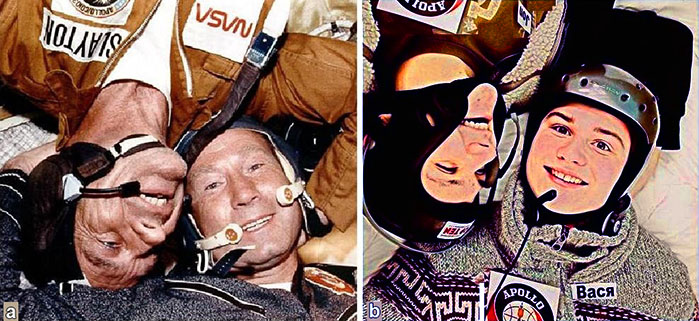
Figure 1. a) D. Slayton and A. Leonov allegedly taken in orbit with a 35mm camera (captured Jan 18, 2018); b) the same headshot composition staged and photographed by schoolchildren on their school floor
Figure 1a features D. Slayton and A. Leonov allegedly taken while in orbit. At the request of the author two young men donned helmets and fastened Apollo-Soyuz insignias to their chests. They then positioned themselves on the floor, and a friend photographed them from above. They were able to produce a virtually identical result.
Astronaut takes a picture of the Soviet crew in flight
In Figure 2 A. Leonov and V. Kubasov were allegedly photographed in orbit by an American astronaut. But who else could have taken a picture of the Soviet crew in orbit?
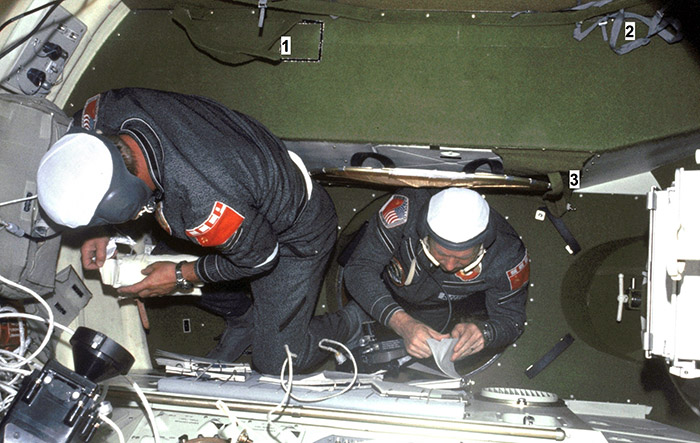
Suppose that this photo session took place on Earth and that the Soyuz mock up was placed in a vertical position. With the partition between the Soyuz compartments oriented horizontally acting as a floor, we, together with the photographer, look down at this scene from above. The soft straps marked 1 to 3 are now considered.
In Figure 3 these straps are shown in close up. It can be seen that ALL three straps lie down together on the floor. What kept them in contact with the floor, if not their own weight?

Figure 3. Enlarged fragments of Figure 2. Soft straps 1, 2 and 3 lie together on the floor under their own weight
It would be very easy to position A. Leonov half way out of the hatch. It would only be necessary to ensure a support under his feet. That’s all. It is entirely possible for such a scene to be successfully staged on Earth, in the very same Soyuz mock up that was used in the space training center in 1974 for the broadcast from orbit footage (Chapter 4).
Dinner party
In Chapter 10 the author pointed out something we will recall in this chapter. If a person wears a jacket on Earth, and if s/he bends the arm at the elbow, the sleeve of the jacket sags at its lowest part, but its upper surface fits snugly to the arm. This fact applies to outerwear, but to not anything elastic, because elasticised clothes would hug an ankle or wrist.
Whereas in a reduced-gravity environment, the cuffs of clothing bulge from the arms and legs in various directions. Now let us return to the analysis of photos from the NASA gallery1. Here, T. Stafford and D. Slayton, supposedly in orbit, visited the Soyuz to participate in a symbolic international meal (Figure 4).
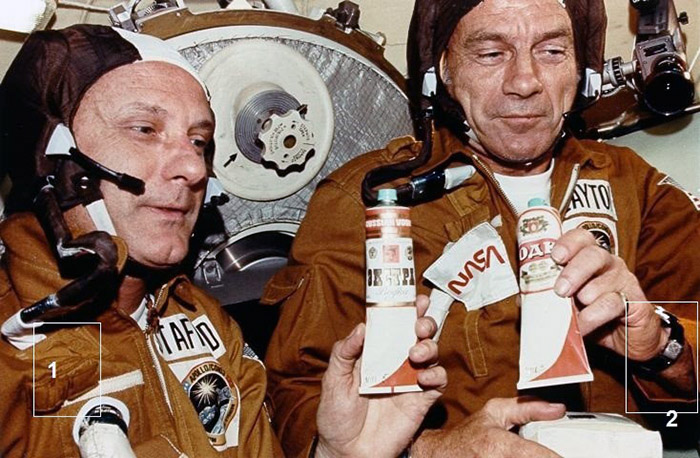
Numbers 1 and 2 in Figure 4 were added by the author. Here, framed, are areas of the image that attracted the author’s attention. Figure 5 shows these fragments in close up.

Figure 5. Enlarged areas from Figure 4
We now study Figure 5a. The upper part of the Stafford’s patch pocket forms a horizontal surface, on which a thread lies quite comfortably. In weightlessness, the thread could float anywhere, but for some reason it has gravitated downward. In the enlarged part of the frame in 5b one can see how the lower part of the Slayton’s cuff (marked 2) sags under its own weight and how tightly its upper part is pressed against his arm. The likely conclusion is that the photo in Figure 4 was also taken on Earth.
Two friendly commanders
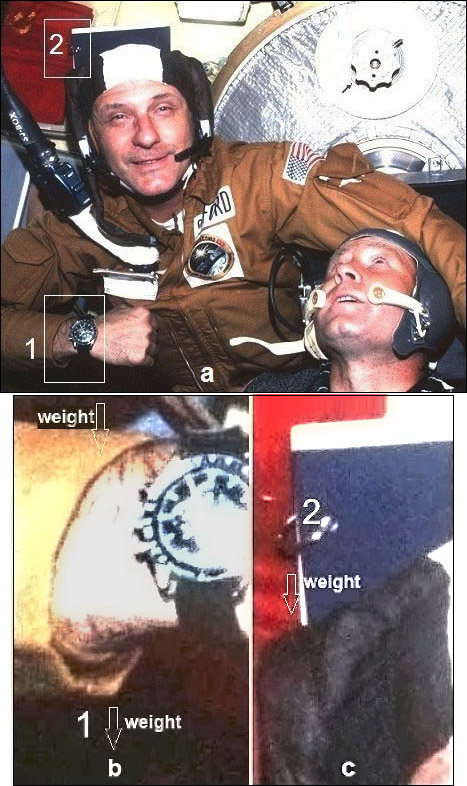
Figure 6. a) Astronaut Thomas P. Stafford (left) and cosmonaut Aleksey A. Leonov are photographed together in the Soyuz Orbital Module; b) enlarged fragment 1; c) enlarged fragment 2 (captured July 28, 2016)
Figure 6a shows T. Stafford and A. Leonov in the same Soyuz Orbital Module. Numbers 1 and 2 in Figure 6 were added by the author. Framed here are parts of the image that interested the author. These parts of the image are shown in close up on the right.
No. 1 in Figure 6 marks the upper and lower parts of the Stafford’s arm. It can be seen how the lower part of the sleeve sags and note how tightly its upper part is pressed against the arm.
No. 2 in Figure 6 shows a metal ring on the binding of a folder. It clearly drops down under its own weight. Again, everything as it would be if this picture was taken on Earth.
In the transition tunnel
Figure 7 depicts T. Stafford and A. Leonov, photographed in the transition tunnel.
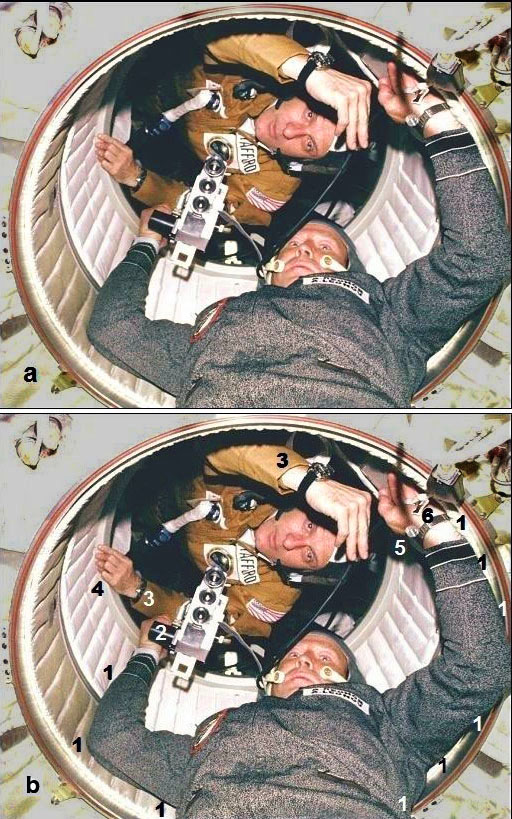
Figure 7. Commanders are seen at the hatchway leading from the Apollo Docking Module to the Soyuz Orbital Module a) the original picture, b) the same picture with overlaid numbering (Captured July 28, 2016)
A. Leonov’s body seems to be ‘glued’ to the floor of the tunnel along its entire perimeter, shown in Figure 7b with dark and light labeling as No. 1. It is difficult to imagine such an extensive attachment of the body in weightlessness. The end of the hatch corresponds to the position of the cosmonaut's lower back. In zero gravity the body wouldn’t feel this. But in 1g bending backwards would be very unpleasant. Is this the reason why A. Leonov looks rather pained and somewhat tense? We can’t see how his legs are oriented. Most likely, they drop down under their own weight.
Apparently Stafford is held over Leonov with the aid of hidden supports or suspension, nevertheless in a very uncomfortable position. And it takes some effort to hold this pose. The fingers (4) of Stafford's left hand clutch at the rim to help keep his body balanced. Whereas in zero gravity, no effort would be required to maintain any posture.
We now consider Figure 8, where there are some enlarged close ups from Figure 7b.
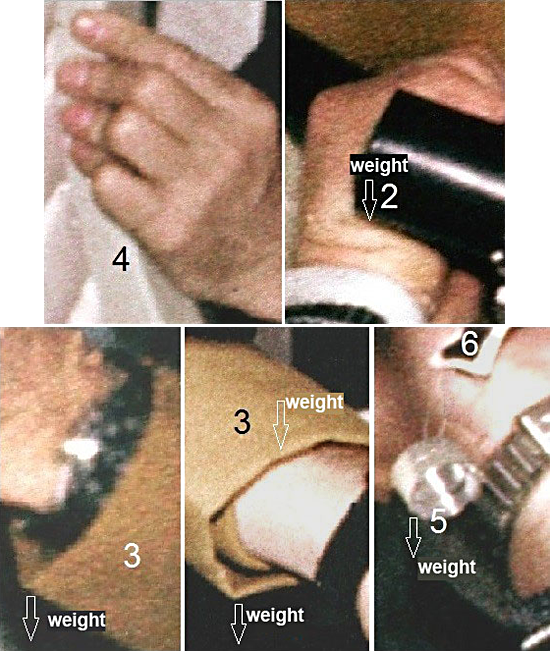
Figure 8. Enlarged parts of Figure 7b (captured July 28.7, 2016)
The handle of the camera (2) is pressed into A. Leonov's right fist just in the supposed direction of weight. And clearly visible is the wrinkle in the skin of the cosmonaut's right hand likely caused by the downward pressure.
On the left, above the handle of the camera, Stafford’s left sleeve is visible (white number 3). The lower part of his cuff is hanging down, and the top is pressed onto his hand. Everything is as on Earth. Stafford's right sleeve cuff behaves similarly (black number 3).
Also interesting is the grouping of items a cap (5), which is fastened by two threads together with a tag 6. All these items clearly sag downwards onto Leonov’s hand.
Various signs of the weight of objects are in evidence in Figure 8, and there are numerous such examples.
Why do all the items in the Apollo craft rest on the shelf?
In Figure 9a, according to NASA’s caption, T. Stafford and W. Brandt were photographed in the Apollo command module, allegedly during the joint flight in orbit. However, look at the area framed in Figure 9a. In Figure 9b this fragment is enlarged. Positioned on the shelf is a cylindrical object with a tip below. It is clearly not fixed and leans with its weight on the edge of the window.
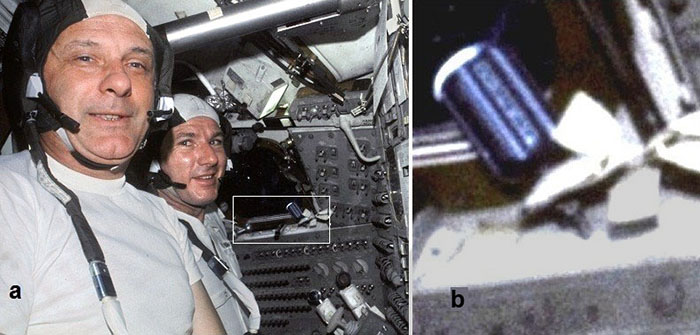
The conclusion here as a result of studying these examples is that the above series of NASA images demonstrate the presence of weight, which could not possibly occur if these photographs had been taken while in low-Earth orbit.
ISBN: 978-1-898541-19-6
Aulis Publishers, January, 2019
English translation from the Russian by BigPhil

References:

This chapter is licensed under
a Creative Commons License