Jack White's Apollo Studies 10

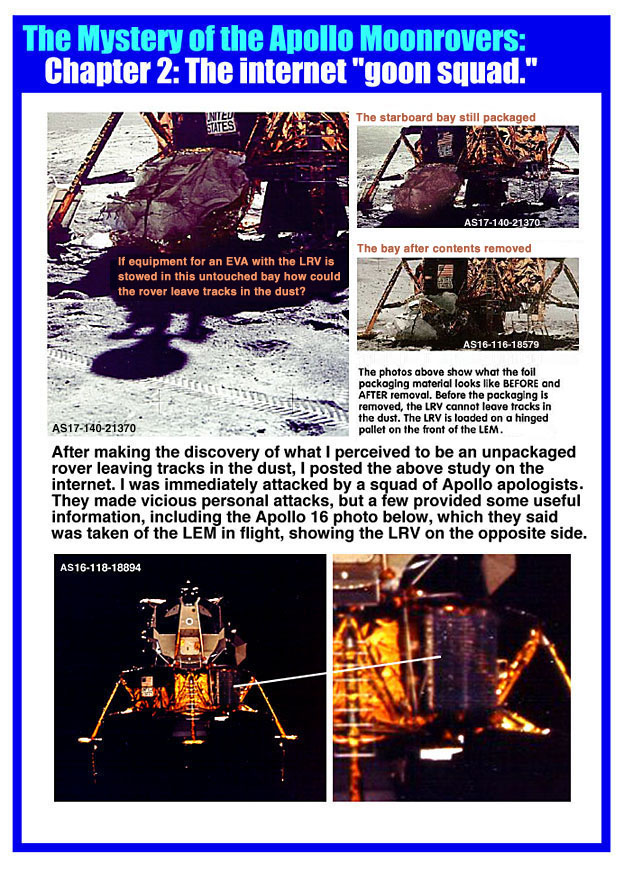

Editor's Note: See also earlier Apollo 16 study: Computer reveals crude retouching of Apollo16 LEM. The point made by Jack White "...not a single photo of an LRV attached to the port side of a LEM can be located" may require clarification. It appears that he is referring to lunar surface photos of the stowed LRVs. The only photo of an LRV apparently on the port side of a LM is one depicted in flight against a black background AS16-118-18894. But as Jack White has demonstrated, the photograph is suspect because he has found that this 'in flight' image was retouched.

Editor's Note: Although there was TV coverage of lowering the Apollo 15 LRV from the port side, which was somewhat lacking in detail, there were no Hasselblad still photographs of this operation taken on any of the Apollo missions.

Editor's Note; The answer to 'What was in the package?' is that the starboard stowage bay, QUAD IV, was the location of the Modularized Equipment Stowage Assembly (MESA). This is where a number of items were stowed. These are said to include camera lens items, geology tools, sample containers, communications equipment and so forth. Although there was lo-res, rather indistinct, TV coverage of lowering the Apollo 15 rover, there were no Hasselblad still photographs of this operation taken on any of the missions.
No doubt if there was the will, the unloading operation could have been halted for a few moments in order to photograph unstowing the LRV for posterity. Some may question whether the stowed LRV in the Apollo 16 image AS16-118-18894 on the previous page (compared with say AS16-116-18579) is consistent with the bulk of the folded LRV, as depicted in the above BW photograph.
With
and without extra lighting

Overlay
used to add US decal to LM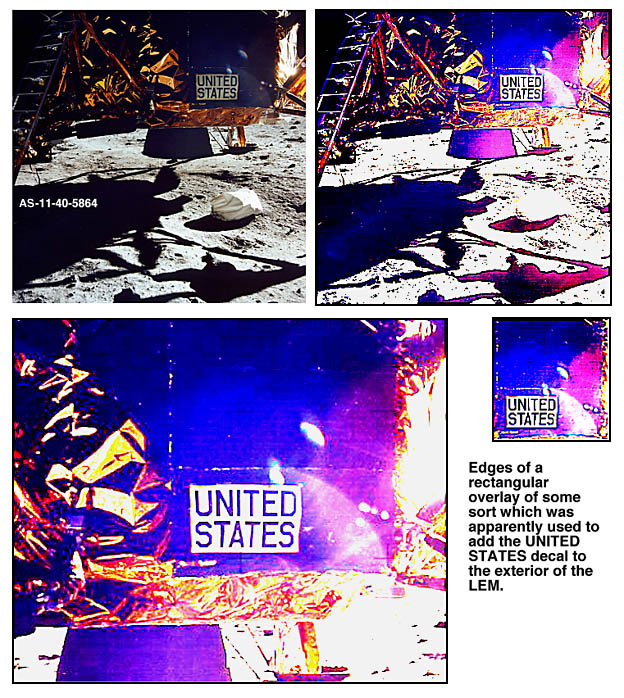
LM
black patch anomaly
Editor's Comment: There is far more to this image than meets the eye. Regarding the black paper-like material that was added – it is obviously not a part of the LM, therefore it must have been an addition made during the photo shoot – no doubt by a whistle-blower. Was the purpose to draw attention to the LM itself, or perhaps to a situation the photographic team were unhappy about?
This 'black paper' anomaly does not appear in other photographs, and must have been added ON THE SET.The astronauts certainly had no reason whatsoever to add it, nor had they the material to add it while ON THE MOON. This photograph alone proves fakery, since it was added over the US decal. And hopefully the NASA Press Office has the answer as to what the object may be that is reflected in the helmet.

Editor's Note: It was researcher Bill Kaysing who first remarked that photographs should depict dust on the surface of all footpads. He reasoned that the descent engine would throw up quantities of lunar dust that would settle on the upper surfaces of the gold foil. "The insulation on the secondary struts of the LM was damaged by heat – but the primary struts were only singed – or covered in soot." Apollo 11 – The NASA Mission Reports Volume 3.
The NewScientist Letters to the Editor, 2005
Missing Moon Dust from George Tetbury
"In your article on moon dust you reveal that Apollo 11, 12, 15 and 16 experienced poor visibility while landing (28 May 2005 p.40). But we have photos of the feet of the lander standing on the lunar surface with not a speck of dust on them. If all the dust was blown away during the landing, Neil Armstrong's historic first step would not have left an imprint. What are we to believe?"
George Tetbury, Glasgow, UK
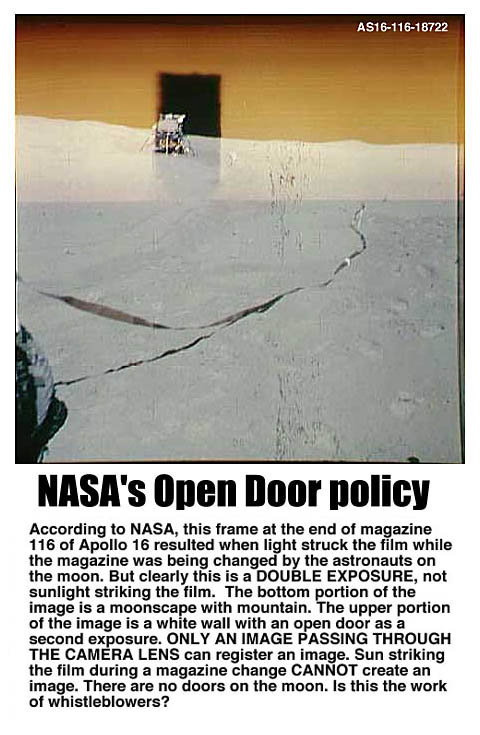
Editor's Note: Perhaps Jack White should have used the word PICTURE instead of IMAGE. It is well known that film manufacturers expose "images" of numbering and lettering using mechanical exposure through masks during manufacture. And a roll of film can be accidentally partially exposed to light during handling. Both of these may "create" images on the film, but neither creates a "picture". A picture can only be formed by a conventional light image passing through a lens aperture. An exception is the passing of X-RAYS through something, forming a shadowgram on film. The above discussion concerens the Hasselblad still photographs and not X-rays, accidental exposures, or manufacturers' markings.
End Note: Everyone expects NASA to behave with honesty and integrity, but in the case of Apollo, both qualities appear to be sadly lacking.
