September 2025
Billionauts’ space tourism and Mars fantasies need to be pulled back to Earth
Space Pollution from Rocket Launches
Although a rocket launch releases on average a seventh of the carbon dioxide emitted by an aeroplane, it emits hundreds of times more carbon soot particles than a plane. Carbon soot, also known as black carbon, absorbs light from the sun and then releases it as thermal energy, warming the surrounding air.
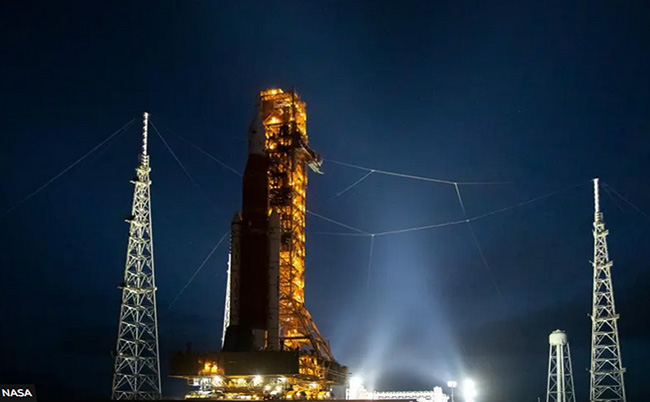
NASA's Space Launch System (SLS)
Space has become the final frontier for tourism. But is it responsible during a climate crisis for the super-rich to play billionauts and boldly go where no billionaire has gone before in search of a Planet B?
Tech billionaire and pioneering space tourist Jared Isaacman is back and he is on a mission to boldly go where no tycoon has gone before. After commanding the first all-civilian space flight in 2021, Isaacman will soon take off on the even more daring Polaris Dawn mission which will enable its crew to venture further into space than any private citizens have travelled before and the furthest for any human in half a century.
Polaris Dawn will orbit in the hazardous Van Allen radiation belt. With a view to pushing the boundaries of commercial space flight, Isaacman and a colleague will embark on a spacewalk without an airlock, exposing all four crew members and the capsule to the radiation and void of space. The spacewalkers will be wearing spacesuits that lack a Primary Life Support System, relying for oxygen on a long hose known as the umbilical.
Whether the risky experimentalism of sending private citizens into space on a high-risk mission with technology that has been untested in space is bold adventurism or the latest example of reckless billionaire folly depends on your perspective, and the eventual outcome of the mission.
Flights of folly
The haughtier ambition of Polaris Dawn notwithstanding, Isaacman is part of a growing trend of megarich space tourists, a phenomenon which began to take off at the dawn of the millennium, when US entrepreneur Dennis Tito visited, in 2001, the International Space Station aboard a Soyuz spacecraft. Other what I call billionauts have included South African tech tycoon Mark Shuttleworth, Iranian-American engineer and entrepreneur Anousheh Ansari (the first female space tourist), Amazon founder Jeff Bezos, and others.
But is space tourism responsible conduct during a climate emergency and given the myriad other problems facing our home planet?
While the carbon footprint of an economy-class passenger taking a long-haul flight is in the vicinity of 3-5 tonnes, the emissions for a space tourist are astronomically higher, as much as 100 times higher per tourist, according to one estimate. Just how high depends on the type of trip, the spacecraft used and the number of passengers.
Creating the necessary thrust to reach the escape velocity required to break free of Earth’s gravitational pull requires the burning of a phenomenal amount of fuel, as anyone who has witnessed the takeoff of a spacecraft can attest.
The Falcon 9 launcher that will propel Isaacman and his crew into space releases nearly 28,000 tonnes of greenhouse gases, while SpaceX’s Starship, the largest vehicle ever to fly, emits 76,000 tonnes, according to one analysis. And this only covers the actual flight. It does not, for example, include design, manufacturing, testing and disposal.
Sooty footprint
Space travel has other adverse effects on the climate and environment. The hot exhaust produced by rocket thrusters actually alters the physics and chemistry of the surrounding atmosphere as it passes through it.
Rockets release a huge amount of water vapour into the atmosphere, and this occurs at considerably higher altitudes than with aeroplanes. While water sounds harmless, high in the atmosphere, where there is almost no water, it has a potent warming effect.
The high temperatures generated during launch and re-entry transform the nitrogen naturally in the air into nitrogen oxides, potent greenhouse gases.
Some two-thirds of the exhaust from rocket launches is absorbed in the stratosphere (second layer of the atmosphere) and the mesosphere (third layer). Scientists do not yet fully understand the long-term effects of pollution so high up in the atmosphere, with some dubbing it the “ignorosphere”. However, scientists are now attempting to penetrate the fog around the climate impact of rocket launches.
In addition to their warming effects, nitrogen oxides and water vapour pumped into the stratosphere deplete the ozone layer by converting ozone into oxygen. This could, in future, threaten the recovery of the ozone layer that has accompanied the decades-old phasing out of chlorofluorocarbons.
“Routine space tourism launches may undermine progress made by the Montreal Protocol in reversing ozone depletion in the Arctic springtime upper stratosphere,” one study warned.
Although a rocket launch releases on average a seventh of the carbon dioxide emitted by an aeroplane, it emits hundreds of times more carbon soot particles than a plane.
Carbon soot, also known as black carbon, absorbs light from the sun and then releases it as thermal energy, warming the surrounding air. In the atmosphere, soot falls back down to the ground in a matter of weeks. However, in the stratosphere, it can hang there for up to four years, prolonging its damaging effect. This is reflected in the fact that even though rocket soot represents only 0.01% of soot emissions, it was responsible for some 3% of the global warming effect caused by the soot humanity pumps into the atmosphere, according to one estimate.
More worryingly still, a rocket launch upsets the delicate carbon dioxide balance in the higher reaches of the atmosphere. Starting from around 43.5km up, a Falcon 9 – a launcher used by SpaceX, including on the upcoming Polaris Dawn mission – spews out more CO2 than is contained in a cubic kilometre of air for each kilometre it climbs, researchers calculated. At 70km, this climbs to an astounding 25 times the C02 in a cubic kilometre of surrounding air.
Meanwhile, when it comes to the growing climate impact of space tourism and the commercial space sector, our governments risk reneging on their responsibilities. Adrenaline rushes for the wealthy should not cost the Earth.
Source: Carbon Market Watch
