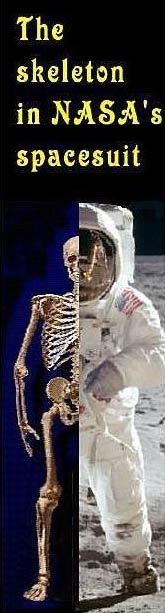
The Skeleton in NASA's Spacesuit
|
|





I have great admiration for many achievements of NASA. I admire the courage, dedication and sacrifice of the astronauts who died in
their pursuits of new frontiers proposed by President John Kennedy
in 1960 when he pledged to put a man on the Moon by the end of the
decade. I am saddened by the deaths of the Columbia and Challenger
scientists who trusted NASA with their lives. On my office television
in 1986 I saw the live explosion of the Challenger. And I watched
in horror that bright February morning as the space shuttle Columbia
broke apart in a smoky trail over my Texas home in 2003. I am saddened
by the deaths on a launchpad in Florida in 1967 of Apollo 1 astronauts
Gus Grissom, Ed White and Roger Chaffee, who may have known too
much for their own security.
I marvel at the achievement of the Hubble Space Telescope, which brings us dream world images from the infinity of outer space. And the images from Mars also help us understand our universe.
But the thousands of honorable workers at NASA will be shocked and saddened to learn of the dark secrets of forty years ago – the Apollo Moon missions. Examination of NASA records reveals a terrible skeleton rotting away in their own files, a monumental deception. Very few NASA employees knew about the ruse, although it continues to be covered up to this very day by some secret keeper of the national security keys. Most likely this was a TOP SECRET political/military project.
This skeleton in the NASA closet is documented by the space agency itself. And the facts provided are indisputable. As Shakespeare might have said, the agency is "hoist with their own petard" – that is, blown up by their own devices.
What is this dirty secret?
Grave doubt exists that the Apollo missions to the Moon were anything more than the most incredible hoax of all time. Did astronauts actually go to the Moon? I do not know. But NASA's own evidence shows that all photos of the Apollo feats had to be forgeries. They were likely made in a secret Earthly studio somewhere as a top secret military project. And if all the "Moon photos" of all the "Moon missions" were fakes, the question is 'why?'.
Real missions should have produced real photographs.
To understand the "why" of faking "landing a man on the Moon by the end of the decade" that had been promised by JFK in his first speech to Congress, one must go back to the Cold War with the USSR and the much-touted "space race". In the early 60s, the Soviets were ahead of the US in space exploration. Sputnik and other Red successes evoked a US political crisis. But the Soviets likely knew that sending a man to the Moon was an immensely difficult task and that JFK's rhetoric was a hollow promise.
However, after Lyndon B. Johnson succeeded the assassinated Kennedy he likely came up with a brilliant (and evil, in my opinion) idea. He must have thought, "...the experts say we can't go to the Moon like Kennedy promised, but I say we can! We can FAKE IT!" If LBJ could pull it off, to simplify a very complex Cold War situation, it would be a great propaganda coup and establish US superiority over communism. So I theorize that LBJ conspired with his successor Richard M. Nixon and OTHERS to carry out an elaborate plan to fool the world by "flying to the Moon". It was a brilliant plan, executed in strict military secrecy, and it has fooled the world for more than 40 years. But it has been undone by its own excesses, as now revealed from NASA records for the first time.
Anyone with even elemental math skills and common sense can look at the facts, do the calculations, and come to their own conclusions about the alleged MASSIVE VOLUME of lunar surface photography in such a LIMITED TIME.
Here is my conclusion: IT COULD NOT BE DONE.
It boils down not to just studying the photographs for signs of fakery, though I have examined every available Apollo photo for more than three years (and discovered many fakes). Very simply, it amounts to a study known to many businesses...A TIME AND MOTION STUDY. The elementary question is: was it possible to take the known number of photos (from NASA records) in the amount of time available (from NASA records)? But before you read my study, to understand it you need to know some basic information about the Apollo missions:
1. Of seven Apollo missions to put "men on the Moon", six were claimed to be "successful". (Apollo 13 was "aborted".)
2. Each of the six successful missions landed two astronauts "on the Moon" in a flimsy craft NASA originally had called the Lunar Excursion Module (LM.later shortened to LM), an unproven craft which never had an opportunity for a lunar landing test flight. But it landed and then took off six times with spectacular "success" on Apollo missions 11 and 12, and 14 through 17...once even landing within 200 feet of a pre-selected target.
3. Two astronauts rode each LM to the Moon surface while one remained in the orbiting Command and Service Module (CSM) awaiting their return.
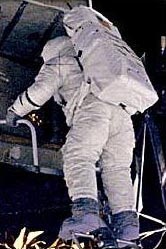
4. During their Extra-Vehicular Activity (lunar surface exploration) each of the two wore a bulky inflated spacesuit with clumsy gloves, greatly limiting mobility. On their backs they wore a huge and heavy Life Support System (PLSS) backpack containing an oxygen tank and circulating water air conditioning system which pumped refrigerated water throughout the suit to counteract the 200+/- degree heat (and cold) of lunar conditions. Pumps circulated both refrigerated air and water to the liquid cooling undergarment, as well as dehumidifying, removing carbon dioxide, and providing all other functions needed to survive harsh conditions in the confining suits.
5. The principal objective of all six missions was SCIENTIFIC RESEARCH projects to be carried out by the two astronauts. Most of the projects, which numbered about a half dozen each mission, were remarkably similar on all six missions. All of these science experiments involved unpacking equipment from stowage bays, assembling it, transporting it to its location, setting it up, and then doing the experiments. As you might imagine, each of these research projects would require a major portion of the TIME of the two men for each experiment.
6. Another major project besides operation of the packaged experiments was the Geological Study, which involved searching for different specimens of rocks and soils in various locations, documenting and collecting samples to return to earth. This obviously occupied much of their TIME.
7. Considerable TIME was needed for "housekeeping chores". After landing, the LM had to be inspected to make sure it had not been damaged. Communications equipment to put them in contact with Earth had to be set up and operated, including radio and television antennas and TV cameras. The US flag was planted in the moondust on each mission. All of this was done before any experiments were initiated. Oh, and don't forget the "ceremonial" chat with President Nixon during Apollo 11.
8. The first three missions required the astronauts to walk to each experiment location. The last three missions were supplied with a Lunar Roving Vehicle (LRV) to travel to distant locations miles away from the LM. The partially pre-assembled LRV was attached to the outside of the LM. The rover floor served as a pallet which was hinged to the outside of the LM. The wheels were folded under. The "pallet" was lowered by hand to the lunar surface, and the wheels rotated into position. After the wheels were down, the vehicle had to be outfitted with all of its considerable equipment from various storage bins of the LM. Oddly, not a single photo exists in the public domain (at least that I could find to date) of the astronauts assembling and equipping the LRVs. The battery-powered rovers had a top speed of about 8 mph, only slightly faster than walking...much like a golf cart. During the LRV travels ("traverses"), both men rode, and when moving, had no opportunity for photography. Also, the time taken in assembling the rover was not used for any photography. Though I could find no time given by NASA, surely it is reasonable to guess that it took at least an hour to unload, assemble and equip and test a rover?
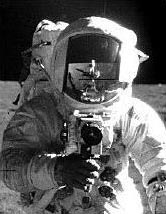
9. Almost incidental to the main astronaut tasks was PHOTOGRAPHY. Each astronaut had his own camera. (Apart from the Apollo 11 EVA.) It was a square-format specially-built Hasselblad. It was mounted on a chest-plate for the astronaut to operate. The astronaut had to manually set the shutter speed and apertures while wearing bulky, pressurized gloves and without being able to see the controls. The cameras had NO VIEWFINDER, so the astronaut could only guess at what was being photographed. Each camera had a bulk film magazine holding more than a hundred exposures. The film (mainly Ektachrome color film) had a very narrow exposure range, which required PERFECT aperture and shutter settings, because according to NASA, the cameras did not have automatic exposure capability.
10. It is important to know that although each man had his own camera, they ALMOST NEVER USED THEM AT THE SAME TIME. Usually one of them was photographing the other doing some task. Therefore having two cameras DID NOT TRANSLATE TO TWICE AS MUCH TIME FOR PHOTOGRAPHY, as one might surmise. Now that you understand the missions, here is my discovery of NASA overzealousness, which has been successfully hidden till now.
A TIME AND MOTION STUDY
For more than three years I have been collecting and analyzing nearly all the significant photos from the Apollo missions. These official photos are readily available on multiple NASA websites for downloading. Recently I noticed they were taking up many gigabytes of memory on my computer's external hard drive, so I began organizing them and deleting duplications. I did a rough estimate of the number of Apollo photos, and was amazed that I had thousands!
I visited several official NASA websites to find HOW MANY PHOTOS WERE TAKEN on the surface of the Moon. Amazingly, NASA AVOIDS THIS SUBJECT almost entirely. Two days of searching documents and text were fruitless. But the Lunar Surface Journal, one of the sites, lists every photo with its file number. So I undertook to make an actual count of every photo taken by astronauts EVA, the time spent on the surface out of the LM.
Here is my actual count of EVA photos of the six missions:
Apollo
11........... 121
Apollo 12........... 504
Apollo 14........... 374
Apollo 15..........1021
Apollo 16..........1765
Apollo 17..........1986
So 12 astronauts while on the Moon's surface took a TOTAL of 5771 exposures.
That seemed excessively large to me, considering that their TIME on the lunar surface was limited, and the astronauts had MANY OTHER TASKS OTHER THAN PHOTOGRAPHY. So I returned to the Lunar Surface Journal to find how much TIME was available to do all the scientific tasks AS WELL AS PHOTOGRAPHY. Unlike the number of photos, this information is readily available:
Apollo
11........1 EVA .....2 hours, 31 minutes......(151 minutes)
Apollo 12........2 EVAs.....7 hours, 50 minutes......(470 minutes)
Apollo 14........2 EVAs.....9 hours, 25 minutes......(565 minutes)
Apollo 15........3 EVAs...18 hours, 30 minutes....(1110 minutes)
Apollo 16........3 EVAs...20 hours, 14 minutes....(1214 minutes)
Apollo 17........3 EVAs...22 hours, 04 minutes....(1324 minutes)
Total
minutes on the Moon amounted to 4834 minutes.
Total number of photographs taken was 5771 photos.
Hmmmmm. That amounts to 1.19 photos taken EVERY MINUTE of time on the Moon, REGARDLESS OF OTHER ACTIVITIES. (That requires the taking of ONE PHOTO EVERY 50 SECONDS!) Let's look at those other activities to see how much time should be deducted from available photo time:
Apollo 11....Inspect LM for damage, deploy flag, unpack and deploy radio and television equipment, operate the TV camera (360 degree pan), establish contact with Earth (including ceremonial talk with President Nixon), unpack and deploy numerous experiment packages, find/document/collect 47.7 pounds of lunar rock samples, walk to various locations, conclude experiments, return to LM.
Apollo 12....Inspect LM for damage, deploy flag, unpack and deploy radio and television equipment (spend time trying to fix faulty TV camera), establish contact with Earth, unpack and deploy numerous experiment packages, walk to various locations, inspect the unmanned Surveyor 3 which had landed on the Moon in April 1967 and retrieve Surveyor parts. Deploy ALSEP package. Find/document/collect 75.7 pounds of rocks, conclude experiments, return to LM.
Apollo 14....Inspect LM for damage, deploy flag, unpack and deploy radio and television equipment and establish contact with Earth, unpack and assemble hand cart to transport rocks, unpack and deploy numerous experiment packages, walk to various locations. Find/document/collect 94.4 pounds of rocks, conclude experiments, return to LM.
Apollo 15....Inspect LM for damage, deploy flag, unpack and deploy radio and television equipment and establish contact with Earth, unpack/assemble/equip and test the LRV electric-powered 4-wheel drive car and drive it 17 miles, unpack and deploy numerous experiment packages (double the scientific payload of first three missions). Find/document/collect 169 pounds of rocks, conclude experiments, return to LM.(The LRV travels only 8 mph*.)
Apollo 16....Inspect LM for damage, deploy flag, unpack and deploy radio and television equipment and establish contact with Earth, unpack/assemble/equip and test the LRV electric-powered 4-wheel drive car and drive it 16 miles, unpack and deploy numerous experiment packages (double the scientific payload of first three missions, including new ultraviolet camera, operate the UV camera). Find/document/collect 208.3 pounds of rocks, conclude experiments, return to LM.(The LRV travels only 8 mph*.)
Apollo 17....Inspect LM for damage, deploy flag, unpack and deploy radio and television equipment and establish contact with Earth, unpack/assemble/equip and test the LRV electric-powered 4-wheel drive car and drive it 30.5 miles, unpack and deploy numerous experiment packages. Find/document/collect 243.1 pounds of rocks, conclude experiments, return to LM.(The LRV travels only 8 mph*.)
Let's arbitrarily calculate a MINIMUM time for these tasks and subtract from available photo time:
Apollo 11...subtract 2 hours (120 mins), leaving 031 mins for taking photos
Apollo 12...subtract 4 hours (240 mins), leaving 230 mins for taking photos
Apollo 14...subtract 3 hours (180 mins), leaving 385 mins for taking photos
Apollo 15...subtract 6 hours (360 mins), leaving 750 mins for taking photos
Apollo 16...subtract 6 hours (360 mins), leaving 854 mins for taking photos
Apollo 17...subtract 8 hours (480 mins), leaving 844 mins for taking photos
So do the math:
Apollo 11.....121 photos in 031 minutes........3.90 photos per minute
Apollo 12.....504 photos in 230 minutes........2.19 photos per minute
Apollo 14.....374 photos in 385 minutes........0.97 photos per minute
Apollo 15...1021 photos in 750 minutes........1.36 photos per minute
Apollo 16...1765 photos in 854 minutes .......2.06 photos per minute
Apollo 17...1986 photos in 844 minutes .......2.35 photos per minute
Or, to put it more simply:
Apollo 11........one photo every 15 seconds
Apollo 12........one photo every 27 seconds
Apollo 14........one photo every 62 seconds
Apollo 15........one photo every 44 seconds
Apollo 16........one photo every 29 seconds
Apollo 17........one photo every 26 seconds
So you decide. Given all the facts, was it possible to take that many photos in so short a time?
Any professional photographer will tell you it cannot be done. Virtually every photo was a different scene or in a different place, requiring travel. As much as 30 miles travel was required to reach some of the photo sites. Extra care had to be taken shooting some stereo pairs and panoramas. Each picture was taken without a viewfinder, using manual camera settings, with no automatic metering, while wearing a bulky spacesuit and stiff clumsy gloves.
The agency wants the world to believe that 5771 photographs were taken in 4834 minutes! IF NOTHING BUT PHOTOGRAPHY HAD BEEN DONE, such a feat is clearly impossible...made even more so by all the documented activities of the astronauts. Imagine...1.19 photos every minute that men were on the Moon – that's one picture every 50 SECONDS!
The secret NASA tried to hide has been discovered: The quantity of photos purporting to record the Apollo lunar EVAs could not have been taken on the Moon in such an impossible time frame. So why do these photos exist? How did these photos get made? Did ANY men go to the Moon? Or was it truly the greatest hoax ever?
© 2005 Jack White
Editor's Notes: *According to Andrew Chaikin, author of A Man on the Moon the LRV averaged only 5 to 7 miles per hour, which would reduce even further the time available for photography.
Timing Out
Taking the Apollo 11 mission as his example, and the Apollo 11
Lunar Surface Journal (1) consulted by
Jack White in this Skeleton article, an 'apollogist' or critic,
has posted a long refutation of the above time and motion study.
This critic asserts that a shot rate per mission calculated on time
available over number of photos taken is inappropriate, since some
pictures took longer than others, and that the pictures were taken
during the tasks over the whole EVA period.
This is not a point that Jack White is disputing.
Taking the Apollo 11 EVA of 151 minutes, the critic would prefer that the photos are evaluated according to his own calculations which split the EVA into 9 segments of 'about 15 minutes each' (2). Working from the Apollo 11 Lunar Surface Journal, this critic has estimated the number of photos taken for each segment.
According to
these criteria there are variable averages of 7.5 minutes (segment
two) to 2.5 minutes (segment six) or 31 seconds (segment seven).
However, when studying the actual mission elapsed time line we can
see that this is not a reflection of the time allowed for photography
at all. Nor is the approximate 15 minute segment a true reflection
of the time taken by each bundle of tasks that this critic has allocated
per segment. Further, while taking Jack White to task for not listing
the EVA tasks in the correct order, the critic splits single EVA
tasks (such as the flag ceremony) across two separate 'segments'
and also splits multiple panorama shots across 'segments'. As it
turns out, this critic's method simply demonstrates that at some
points in the mission fewer shots were taken than at others.
Not a point Jack White is disputing either.
Nor is the critic's argument the same. He proposes that there was plenty of time for photography since it was spread across the mission. Jack White proposes that given the workload, the number of photographs to be taken, and the conditions under which they were taken, there was not enough time to achieve the standard of photography revealed within the official Apollo record. Not to mention the anomalies!
Workload
Jack White's critic demonstrates that he is in a muddle about what
he is trying to prove by recommending the ideal method for ascertaining
accurately the time available for photography. While not doing it
himself, due to the amount of time it would take, he thinks is necessary
to note each shot relative to the mission elapsed timings. Taking
this advice to heart and also checking the tasks of each astronaut
against their individual EVA timings (3) does indeed take hours.
It also produces the following result:
The Apollo 11
EVA workload was ............2hrs 03 minutes
The time allocated to photography was........... 28 minutes
The average time to point-and-shoot .......121 photos was 13.88
seconds
The average time to point-and-shoot .......122 photos (2) 13.77 seconds
These figures demonstrate two things:
a) The role
of astronaut photography in this mission was minimal, and most of
it was of the point-and-shoot variety. Which begs the question regarding
those carefully composed shots.
b) There is a difference between a time and motion study as per
Jack White, demonstrating the time available for photography within
a mission, and the dissenter's demonstration of the moment within
that mission during which that photography took place.
Using the second demonstration as a response to the first is to merely demonstrate these differences, and saying that "White suggests in his study that the work load was such that there should have been two hours with no photography" is a false premise. Yet this statement turns out to be virtually correct when it comes to evaluating the amount of time required for the EVA workload. It would appear that this critic may have done all these calculations and then muddled his paperwork.
As a result of the foregoing, it is clear that Jack White's conclusion of a reserved time of 31 minutes for the Hasselblad still photography across the Apollo 11 EVA, was virtually spot on. We are down to 28 minutes.
In any event,
the crux of the matter is that on average across all missions, one
photograph had to have been taken every 50 seconds even if Apollo astronauts were doing nothing but photography while
allegedly on the Moon.

This article is licensed under
a Creative Commons License
Notes
1) Lunar Surface Journal reference: http://history.nasa.gov/alsj/frame.html used by White, critic and Aulis editor in this matter of the Apollo 11 EVA.
(2) Critic's posting: 'Bad Apprentice': Wed Apr 20, 2005 10:28 pm on badastronomy.com. His segments are 'approx. 15 mins', his total photos is 122:
1. 0 photos; 2. 20 photos; 3. 2 photos; 4. 4 photos; 5. 17 photos; 6. 25 photos; 7. 29 photos; 8. 19 photos, 9. 6 photos.
(3) The Apollo 11, NASA Mission Report volume 3 (complied from the NASA archives, Edited by Robert Godwin) pp 145/174.
"Very much enjoyed your analysis of the number of NASA photos vs available time. I'm also professional photographer so I can appreciate your conclusion, especially given the almost "artist" qualities of a lot of the shots that were supposedly not "framed" but somewhat randomly captured.
At the rate they would have needed to be taken, the whole series of photos from each mission should be expected to play almost like a movie if you were to flip through them. With manual metering and the difficult light conditions, I find it very hard to believe they had such a phenomenal quality rate and that they didn't trash can at least 25% or more of the total.
For Apollo 11 you have 121 shots – it would not be unreasonable to assume that they actually shot upwards of 200 frames. If every shot on every mission was a "usable shot", than that in it of itself would be a PHENOMENAL feat. Obviously this would make the already ridiculous photo vs time rate even more beyond the realm of possibility."
Great work, excellent site
Carl Miller, USA
"Apollo
debates are usually dominated by physics arguments which can be
confusing for most people. Jack White's analysis is breath-taking
in its simplicity: now anyone can understand the evidence and come
to their own conclusion."
John P. Costella PhD
Dr. Costella is a physicist living in Australia

AULIS Online – Different Thinking