Apollo-Soyuz: The Joint Hoax?
Chapter 10
Handshake "in orbit" filmed on Earth
"…stormy applause was heard when the hatch of the docking module opened, and Alexei Leonov shook hands firmly with Thomas Stafford."1
Y. Golovanov in his book about the Apollo program
On August 4, 2009, a YouTube user StaffordMuseum, posted a video which, in particular, shows the episode of this historic meeting in space.2 The handshake episode runs for 39 seconds in the video which is in three segments: the first of these lasts 22 seconds (from 4:17 to 4:39); the second 11 seconds (from 4:43 to 4:55), and the third 6 seconds (from 5:00 to 5:06). Screenshot time stamps, for example 4:17 (min: sec), are taken from the video timer.
At the threshold of the transition tunnel

Figure 1. The scene of opening the transition hatch and handshakes of A. Leonov with US astronauts2
Figure 1 shows four screenshots from the NASA video.2
Frame 4:17. This is the hatch door of the docking module, with astronaut T. Stafford nearby – the entire scene is captured as if we were inside the Apollo craft.
Frame 4:43. The hatch door is open. Cosmonaut Leonov makes his way through the tunnel along the supposed floor. Between Leonov and the supposed ceiling there is a fairly large gap. Leonov's body is spread out on the floor of the tunnel. Note that Stafford also seems to be leaning on the floor supported by his left hand. Unfortunately, the wrist of his left hand is not fully visible.
Frame 4:48. Leonov has now crawled up, and is shaking hands with Stafford. Stafford, still seems to be leaning on the floor with his left hand. Again, his left wrist is not visible. Leonov, as before, lies on the tunnel floor, resting on his right elbow. Leonov's elbow is pinned to the floor.
Frame 4:54. The other US astronaut shakes Leonov's hand. Leonov lies on the floor in the same position.
Figure 2 is the handshake scene, corresponding approximately to the timestamp 4:48 of the video.2 It allows us to take a closer look at some key details.
This picture clearly shows that Stafford’s left hand is turned at a right angle to his left arm. This is how we would normally rest with our hand on any underlying support – for example, on the floor.
And Leonov, also in the tunnel, rests on the floor, but only with his elbow. Just as it would be if the tunnel was located on Earth in 1g. The direction of the support is the same for both handshakes. This, obviously, is the downward direction of his weight. The author indicates the (downward) direction of weight with white arrows. The concepts of "floor" below and "ceiling" above are now considered further.
It is Leonov’s body weight that is pushing him to the floor of the tunnel and separating him from the ceiling. Moreover, Leonov’s stance is observed not only in the static photograph of Figure 2, but also in all three screenshots from the video (4:43, 4:48 and 4:54), where the cosmonaut crawls along the tunnel floor. These frames cover a time interval of 10 seconds of constant pressing of the cosmonaut’s body down to the floor.
The inevitable conclusion is that both Leonov and Stafford were actually resting on a real (earthly) floor.
Leonov, judging by Figures 1 and 2, stopped moving precisely at the tunnel edge. If he had moved any farther beyond the edge of the tunnel he would have to place his hands on the floor in the Apollo craft, which is at a much lower level. Any such a movement would give away the fact that the handshake sequence must have occurred on Earth.

Figure 2. The handshake, a B/W photograph. While Leonov’s left hand is constantly holding the edge of the tunnel, the US astronaut’s left hand is clearly visible resting on the floor of the tunnel – the white arrows indicate the downward direction of weight (copied by the author July 22, 2016)
The US astronaut "dives" into the tunnel
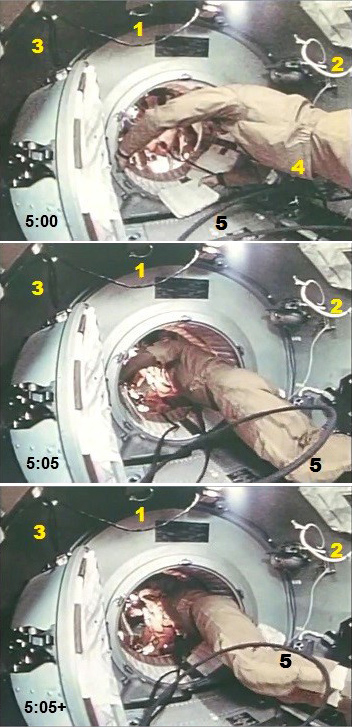
.Figure 3 (left), an astronaut "dives" into the tunnel. The Apollo-Soyuz Test Project Documentary Pt 2 of 32 shows another selection of three screenshots from the same NASA video.2
An unusual time stamp of 5:05+ in the third image means that this frame is at almost the same moment as the previous one, but just a fraction of a second later.
Viewing this video sequence in its entirety, one does get the impression that the astronaut's body is hovering in zero gravity or to use the correct term microgravity*) a condition of weightlessness where g-forces are very small.
However, on carefully viewing this video episode frame-by-frame, this impression of weightlessness disappears.
Furthermore, throughout the video, different shots are intercut quickly – which doesn't provide the opportunity to study the sequence uninterrupted and in its entirety.
We will consider some specific details in the frames – the author has marked them numbers 1-5. Part nos. 1 and 2 in Figure 3 are loosely-sagging cable loops.
In microgravity, flexible cables can take very arbitrary shapes, but when two cables in two different places are sagging downwards in the same manner, and in the same direction, (as they might do on Earth) it does make one wonder (see Figure 3 left, and Figure 4 below).
Part no. 3 in Figures 3 and 4 is not clearly visible, so the author has enlarged it and the object can be seen better in Figure 5. In the two images the loop, hanging almost vertically, is much more visible. It is rather obvious that it hangs under its own weight (Figure 5b).

Figure 4. Cables 1 and 2 sagging. Enlarged fragment of any frame in Figure 3. The arrows show the downward direction of weight.

Figure 5. Hanging loop 3: a) with slightly increased brightness; b) with added brightness.
Part no. 4 is the sagging lower edge of the astronaut's jacket around his waist (see Figure 3 and Figure 6).

Figure 6. Enlarged part of Figure 3 (frame 5:00). Note the sagging edge of the astronaut’s jacket
|
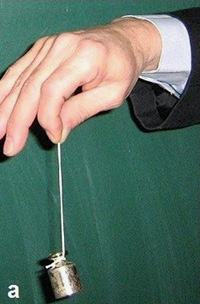
In order to clarify our interest in the astronaut’s jacket, we will digress slightly. A normal jacket sleeve end is shown in Figure 7a – as would be the case on Earth. In the lower part, the sleeve sags and forms an empty space, but above it adheres to the person’s arm.
The same would be true with other outerwear, as long as it isn’t manufactured with elastic material. Obviously elastic clothing clings to parts of the body.
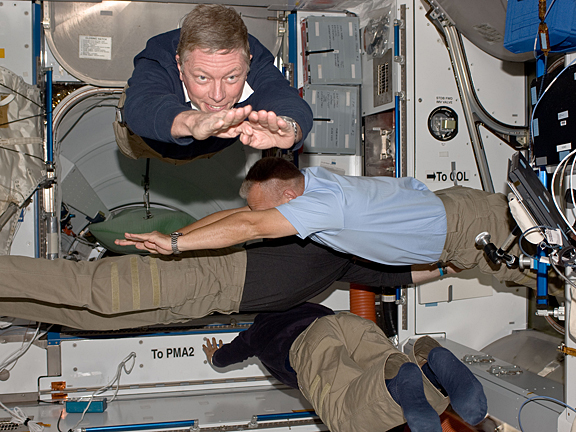
Let's now look at a snapshot taken on the ISS in a condition of real weightlessness (Figure 7b). The soft sleeve of the astronaut’s jacket (1) sags "downwards". But the pant bottoms of the other astronaut (2) "hang" "upwards".
And the third astronaut (3) has the leg bottoms of his pants surrounding his heels all round, hardly touching his feet at all. It is no longer possible to say where the supposed "up" or "down" actually are in these pictures. This is the way it should be in a real microgravity environment where all directions are equal, and objects are weightless.

We now return to the astronaut, pictured in Figure 6. The bottom edge of his jacket hangs from his stomach, while the top edge of the jacket is pressed tightly onto his back. This fact indicates that the edge of the jacket is pulled down by its weight – it’s not weightless. The weight direction is indicated in Figure 6 with a white arrow.
Part no. 5 in Figure 3, the loops of a large and, judging by its form, a fairly stiff cable or hose is visible. During the sequence, this hose occasionally goes down and then up again. But, basically, all the manoeuvres of the hose are in the lower half of the frame and, if it is not pulled, then it tends to lie down on the astronaut himself. It seems that it is the weight of this hose that presses it against the astronaut's body.
The hatch door in Figure 3 is present in all the other handshake photos. The door opens sideways. We should not forget that we have already established – quite definitely and not hypothetically – where the floor and ceiling were located (see Figures 2, 4, 5 and 6). Therefore the concept of "the door opening sideways" is also not hypothetical.
As we know doors open sideways on Earth i.e. to the right, or to the left. Coincidentally, the hatch door also opens the same way in the handshake episode.
Consequently, how then can the horizontal position of the astronaut's body be explained in Figures 3 and 6? Indeed, the first thing that comes to mind when initially watching this video is that this is real zero-g. Nevertheless, the facts discussed above offer several good reasons to doubt this. Even more detailed frame-by-frame analysis of the diving into the tunnel episode deepens these doubts.
We need only 4 screenshots (Figure 8) and now the frame time is given in hundredths of a second.

Figure 8. Diving into the tunnel episode – analysis using a video editing app
Figure 8a shows the chief of the Soviet Mission Control Center, A. Yeliseyev. The frame with this timestamp (5:00.37) precedes the diving into the hatch episode. There are no other frames between frames 8a and 8b.
In Figure 8b, the astronaut already has both hands on the tunnel wall, that is to say, he already has a point of support for his body. There isn’t a single frame in the entire video where the astronaut doesn’t touch the tunnel walls!
Then an obvious question arises: is there a second support around the astronaut’s feet? Perhaps the astronaut perform a push-up from the floor. Nothing contradicts this assumption. Because in Figure 8b the astronaut’s feet are hidden from the viewer.
Figure 8c is the last frame of this episode. We will look at the astronaut's feet. The right foot is suspiciously close to the floor and, quite possibly, rests on it. But as ill-luck would have it, the very tip of the right foot sock is "accidentally" not shown. And what is the astronaut's left foot, positioned a little higher, doing? Again, we cannot see anything, since the left foot is also "accidentally" hidden outside the frame.
These are good questions but there are no good answers. The entire situation remains highly questionable.
What would it have taken for the movie/TV cameraman to clarify the situation? For this it would have been necessary to show only one following frame, and then maybe we might have seen some freely-floating feet! But that does not happen. And the cameraman does not show the astronaut's feet completely as obviously it was impossible to show them. Apparently, the astronaut was actually in a sustained "push up from the floor" pose, with his feet anchored.
The entire 7-second episode of "diving" into the tunnel ends at the time stamp 5:07.56. After 0.03 seconds the next frame shows a completely different scene (Figure 8d).
It must be concluded, therefore, that both the handshake episode, and the scene with the astronaut "diving” into the tunnel, were filmed on Earth.
Furthermore, as a respected colleague of the author has noted,
It wasn’t for nothing that is was Leonov's crew that was sent into space, despite the blatant contingency with the TV failure at the launch pad. No backup crew could possibly replace the real hoax participants, who in advance, in July 1974 (see Chapter 4), had taken part in all the necessary filming of the video sessions and photos with simulations of weightlessness.
ISBN: 978-1-898541-19-6
Aulis Publishers, September, 2018
English translation from the Russian by BigPhil


References
*micro-g, µg – microgravity, weightlessness where g-forces are very small. In orbit people and objects are actually in free fall. The International Space Station is in a micro-g environment.
Internet links verified January 17, 2018
- Y. Golovanov, The Truth about the Apollo program, EXMO Press, 2000, ISBN 9785815301061 (Rus.)
See Chapter X for the text on the docking, Afterword “Handshake In Orbit”
- NASA video clip (9:41) Apollo-Soyuz Test Project Documentary Pt 2 of 3, posted 08/04/2009 on YouTube by StaffordMuseum, NASA link copied on 07/22/2016

This chapter is licensed under
a Creative Commons License