Apollo-Soyuz: The Joint Hoax?
Chapter 8
Mock-ups everywhere
Following the successful reconfiguration of the Soviet on-board TV to operate with the output from the US video player, people around the world were glued to their television screens to watch the link-up event. This memorable occasion was followed by the publication of a number of photographs of the rendezvous 'in orbit'. We will now take a close look at some of these photos.
Soyuz 19 against a background of clouds –
allegedly taken from the Apollo craft
Before docking, both spacecraft had to be in close proximity to one another. According to the official account of the project, at this point in the operation, the Soviet cosmonauts supposedly photographed Apollo through a Soyuz window, and the Americans allegedly photographed Soyuz through their windows.
The image in Figure 1a was obtained from the NASA Apollo Image Gallery.1 The original caption claims that this is a "View of Soviet Soyuz spacecraft from Apollo CM." However, if the contrast of the photograph is increased using a graphics editor it is possible to see (Figure 1b) that through the white background (of clouds presumably) lines of a text are clearly visible. Since no such a phenomenon has ever been observed on real clouds, the only conclusion must be that this text was not on the clouds!
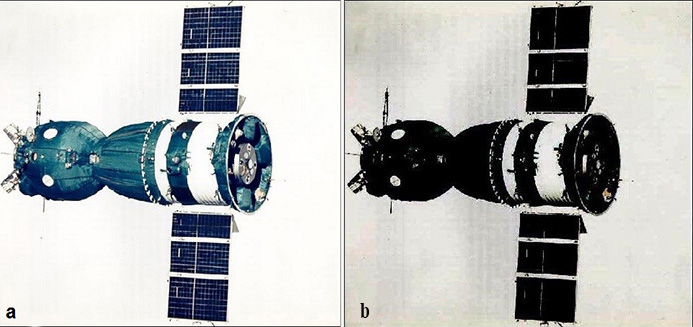
Figure 1a. AST-1-156. NASA caption: "View of Soviet Soyuz spacecraft from the Apollo CM"1 captured July 29, 2016 from the Apollo image Gallery. Figure 1b. The same image as 1a, enhanced with a graphics editor
It is very likely that this is a small-scale model of the Soyuz craft photographed against a sheet of white paper – the white background intended to mimic an even cloud layer. The problem though is that the photographer neglected to appreciate the fact that text was printed on the reverse side of the sheet of paper. It didn't show at the time through the resultant image, so it was probably deemed to be OK. This is a reasonable conclusion to reach in 1974. Back then it was still basically an analog world and of course, there were no computer graphics editing applications.
Having realised that this text was visible through the background clouds of this image, a few NASA propagandists have argued that the website1 had no connection with NASA. It was just a product of a certain community of individuals – a private initiative of some sort. Since this method of disassociation is repeatedly used by NASA propagandists in relation to a wide range of websites, the author considers it appropriate to discuss this denial technique in relation to a specific example on the site.1
On the home page of the Apollo Image Gallery1 it states:
Many photographs on this website are courtesy of the National Aeronautics and Space Administration, specifically the NASA History Office, Kennedy Space Center and Johnson Space Center.
How then, with such solid primary sources, could one or more private individuals obtain a faked photograph? However, even the propagandist’s denial does not work. Because posting such ‘private initiatives’ on a NASA website implies acceptance of their authenticity by those running the website for NASA. And Figure 1a above was obtained from an official NASA website in 2016.
We now move on to consider the photo in Figure 2a. This one was obtained from another NASA website.2 This image (judging by the appearance of the scale model of the craft and its location in the frame) is nothing more than a second attempt to shoot the same composition that was taken in Figure 1a. But compared to Figure 1a (with the white sheet of paper used as a background) in the picture in Figure 2a, the background now includes clouds. Maybe this one was actually taken in space? But it may prove unwise to rush to such a conclusion.
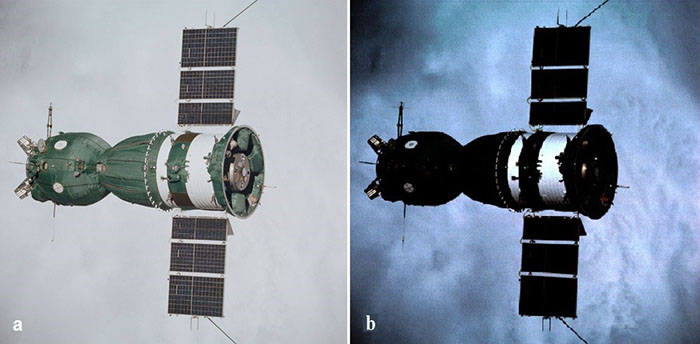
Figure 2a. The original NASA caption reads: "AST-01-056 (18 July 1975) --- An excellent view of the Soviet Soyuz spacecraft in Earth orbit, photographed from the American Apollo spacecraft during the joint U.S.-USSR Apollo-Soyuz Test Project (ASTP) docking mission in Earth orbit. The Soyuz is contrasted against a white-cloud background in this overhead view:"2
Figure 2b is 2a, enhanced with a graphics editor, captured July 29, 2016 from NASA HumanSpaceFlight
After enhancing the picture in Figure 2a with a graphics editor, we obtain the image in Figure 2b. All four corners of Figure 2b are noticeably darker than the centre area of the image. But where would darkened corners come from when photographing a craft in orbit? After all, the sun illuminates the entire Earth’s surface with an even light along the horizon from edge to edge.
To confirm the absence of dark corners on real space photographs, the author searched "photos of clouds from space" and browsed through dozens of cloud images. When the contrast of the original images were increased with a graphics editor the author was unable to find anything like the dark corners of Figure 2b. Darkened corners were not expected, but it was necessary to be absolutely sure that this is the case. See Figure 3 below.
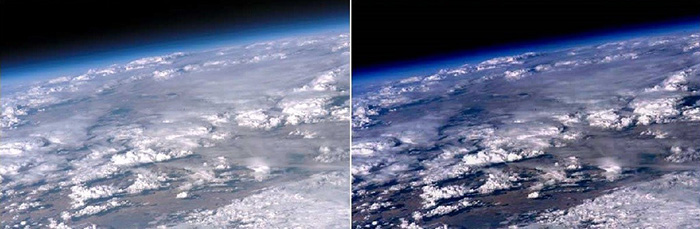
Figure 3. A view of clouds from the ISS. No dark corners. Left – original photograph. The same image on the right enhanced with a graphics editor to assist in spotting any darkening at the corners
The author has an explanation for these dark corners in the picture. The photographer didn’t put a white sheet of paper under the mock-up of the craft, but this time s/he put a picture of real clouds taken from the Earth (all clouds look white when taken in space). Then the entire set up was illuminated from above with a bright artificial light. The use of a directional light is indicated by the strong shadows in the tail area of the craft (Figure 2a). The light was, naturally, directed to the center of the entire composition, so that corners of the composition received slightly less light. Consequently the corners came out darker.
We should also mention that in photography the so-called vignetting effect is well known, which in some cases also leads to noticeably darkened corners in a picture.3 But this effect happens when there is a lack of sufficient lighting and, consequently, it occurs with a wide open lens aperture. However, in space, there is sufficient light and some to spare on the daylight side of the Earth.
These findings strongly indicate that the photographs in Figure 1a and Figure 2a were taken in a photographic studio.
Soyuz 19 image also allegedly taken from the Apollo craft
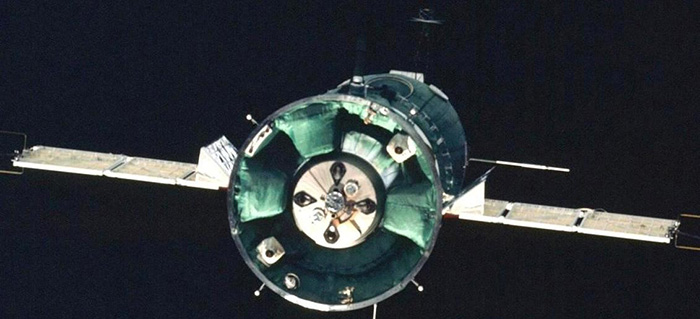
Figure 4. Another Soyuz 19 image, allegedly taken in orbit from the Apollo craft
Here is a further Soyuz 19 image allegedly photographed from Apollo (Figure 4).4 We will now compare this image with what the model of the Soyuz 19 in the US National Air and Space Museum looks like (Figure 5a,b,c). The author has added orange squares to define the support attachments to the exhibit. There are three details highlighted on the museum mock-up: the periscope viewer (1), the VHF antenna (2) and the docking part (3).
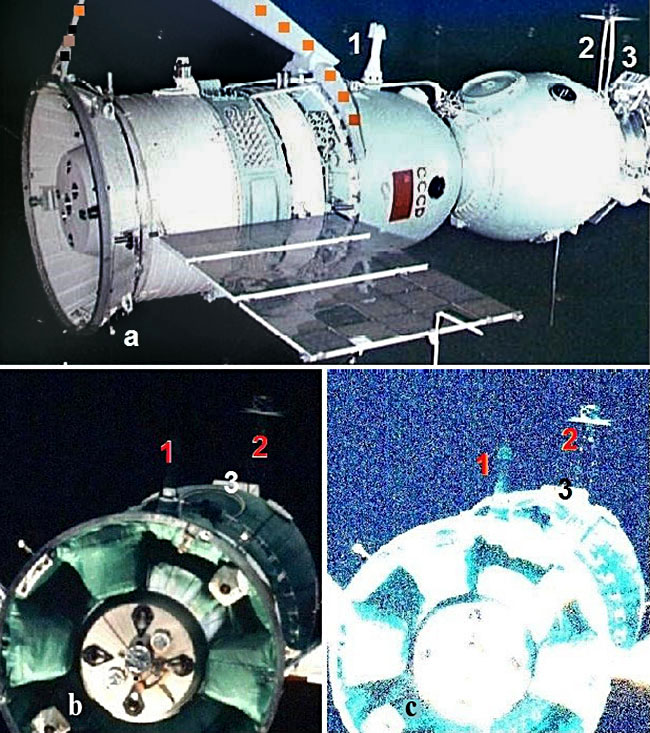
Figure 5 a) Model of a Soyuz 19 in the US National Air and Space Museum; b) the central part of Figure 4, c) the same part enhanced with a graphics editor
Figure 5b shows the central part of Figure 4. Of all the parts 1-3 in this image supposedly taken in space, only part 3 is clearly visible. Regarding part 1, the periscope, only its round base is visible – the column has disappeared into the darkness. The antenna support has also vanished in the darkness. Only the upper part is visible, just.
After processing in the graphics editor it is possible to see that all these details are actually present (Figure 5c). The photographer and the lighting technician neglected to direct sufficient lighting to the upper part of the periscope 1, and to the antenna support 2. Of course in space such a result cannot occur, because the sun in space fills everything with light. No detail would be hidden on the sunlit side of the craft.
The inevitable conclusion therefore is that this Soyuz (Figure 4) was not photographed in space, but in a studio against a black background with artificial lighting.
Three questionable examples (Figure 1a, Figure 2a, Figure 4, and Figure 5), in the author’s opinion, are entirely sufficient to distrust the claim that these Soyuz 19 photographs were taken through the window(s) of the Apollo craft.
Apollo craft allegedly taken from Soyuz 19

Figure 6. NASA caption: The Apollo spacecraft as seen in Earth orbit from the Soviet Soyuz spacecraft… The horizon of Earth is below
Figure 6 is an image of the Apollo component allegedly taken from the Soyuz 19. Let us compare the appearance of this Apollo craft with Apollo-ASTP in American and Russian museums (Figure 7). Both museum expositions, in general, match each other. The one significant difference is that in the American exhibit some spherical tanks are visible on the side of the docking module, or referred to here as the gateway module (G-M), whereas on the Russian exhibit these tanks have a rectangular covering. The docking/gateway module was designed jointly by the United States and Soviet Union, and built in the United States.
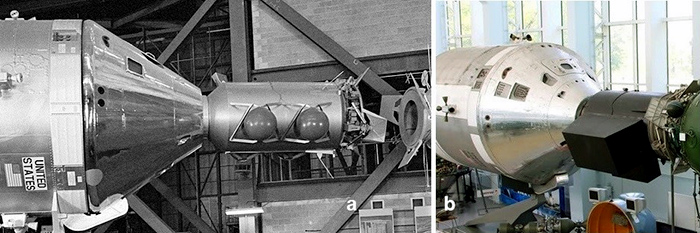
Figure 7. a) Apollo-ASTP in the Kennedy Space Center museum, b) Apollo-ASTP in the museum of RSC Energia
But, when supposedly flying in space, photographs of the Apollo craft (as in Figure 6) correspond to neither of the museum exhibits. In Figure 8, the two images of the G-M are compared with its connection with the Apollo element (A). One is taken from Figure 7a, the other from Figure 6. The scale of the images has been equalised to the diameter of the conical part of the craft used as a reference point. This size is indicated by the orange line. In both images thin white frames have been added to draw attention to the areas where the differences are most apparent.
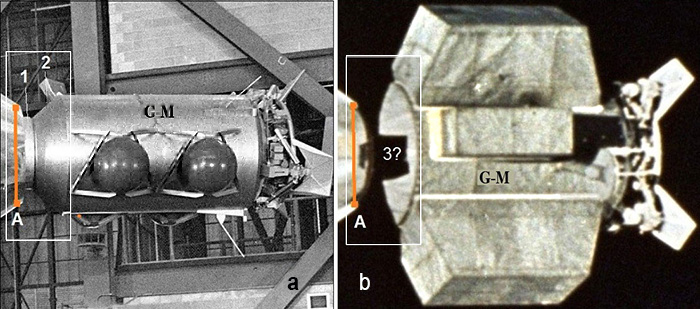
Figure 8. Inconsistency in the adapter from Apollo to the gateway-module on the mock-up in the museum, and on the model allegedly as flown in space; a) the fragment of Figure 7a (museum), b) the fragment of Figure 6 ("in space")
In both museum mock-ups (Figure 7) and in the enlarged fragment of Figure 8a, it is clear that there is a cylindrical ring 1 between the cone A of the command module and the gateway module. But it is absent in Figure 8b.
To the right of the ring 1 is a conical adapter 2 with a bevel angle of about 45°. There is no conical adapter in Figure 8b, but in its place in the center, there is something black and inexplicable, indicated by 3. It seems that the creators of the photograph in Figure 6 attached an incorrectly-constructed G-M to the Apollo model.
While working on this chapter, the author received an interesting letter from a colleague, A. Burganov:
Firstly, look at the nozzle! [in Figure 6] What is circled in red [in Figure 9] resembles a drop of melted and cooled solder that was used to solder the nozzle to the Apollo model. The model manufacturers didn't take care to clean up the soldering. Apparently they thought that before the photo session the photographer would realise that the model should be turned round to show the opposite side, where this solder deposit would not be seen. But it turned out differently. Thank you, careless solderer, and negligent photographer! Your sloppy work has turned out to be helpful many years later.
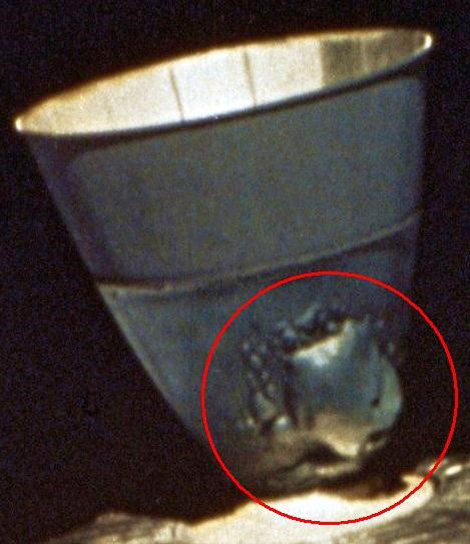
Figure 9. Enlargement of the engine nozzle – a large blob of solder is clearly visible on the nozzle
You can also see that "sunlight" is shining inside the engine nozzle. Obviously, this rocket engine was never fired up. But in any case, what sort of engine can there be in a model?
Secondly, after adjusting the settings in the graphics editor, I noticed a flaw in the halo that depicts part of the Earth's atmosphere, the arrow shows a clear deflection in the atmosphere (red arrow). It is clear that this simply should not be there. In addition, the background "space" is very heterogeneous, scratched and spoiled. In this "space" one can see straight lines/wrinkles (yellow arrows). Apparently, sheets of cardboard, tape and glue were at work here.
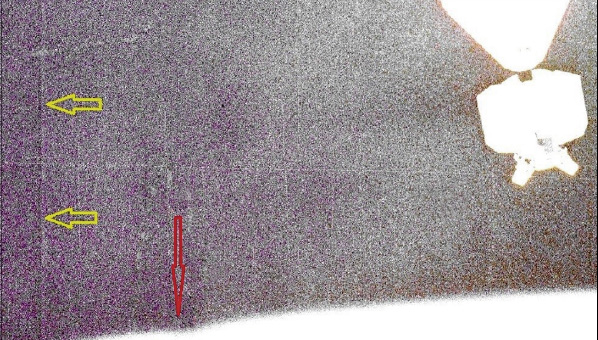
To summarise, it seems that the image of the Apollo craft, depicted in Figure 6, is yet another hack job, photographed against an equally carelessly-produced background.
ISBN: 978-1-898541-19-6
Aulis Publishers, September, 2018
English translation from the Russian by BigPhil


References
Internet links verified January 10, 2018
Apollo Image Gallery, Apollo Archive.com – click on the Post-Apollo listing. Additionally, please see the Apollo-Soyuz Test Project (July 1975) photo, View of Soviet Soyuz spacecraft from Apollo CM.
- Image AST-01-056 (18 July 1975) "An excellent view of the Soviet Soyuz spacecraft in Earth orbit, photographed from the American Apollo spacecraft during the joint U.S.-USSR Apollo-Soyuz Test Project (ASTP) docking mission in Earth orbit. The Soyuz is contrasted against a white-cloud background in this overhead view"
- Article on vignetting in photography
- AST-01-053 (18 July 1975) "The Soviet Soyuz spacecraft is contrasted against a black-sky background in this photograph taken in Earth orbit. This view is looking toward the aft end of the Soyuz"

This chapter is licensed under
a Creative Commons License