Was Einstein Wrong About Gravity?
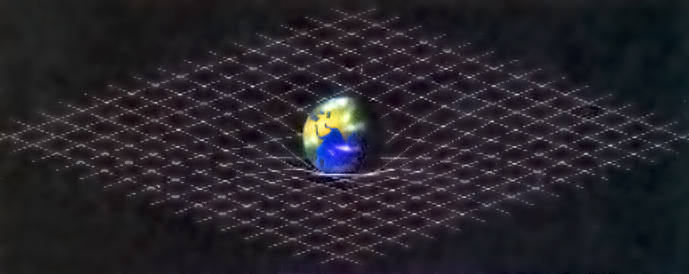
Lattice analogy of the deformation of spacetime caused by a planetary mass according to Einstein’s theory.
In 1905, the same year he received a PhD from the University of Zurich, Albert Einstein developed his famous equation of mass-energy equivalence (E = mc2), which later became known as the theory of special relativity. The only variables in this equation are energy (E), mass (m), and the speed of light (c). Time is not a factor.
In 1908, attempting to better explain his former student's theory of special relativity (E = mc2), mathematics professor Hermann Minkowski expressed it in terms of a mathematical model that fused time and the three dimensions of space into a single four-dimensional continuum – which model became known as Minkowski spacetime.
Notice that the only axes on this diagram are for time and space, neither of which variables are subsumed in the equation, E = mc2. Minkowski spacetime is simply a graphical depiction of an assumed relationship between time and space that has no direct relevance to the variables of energy, mass, and the speed of light.
General Relativity
In 1915, Einstein developed his theory of general relativity, the geometric theory of gravitation that is the current description of gravity in modern physics. General relativity states that gravity is a geometric property of spacetime in which the curvature of spacetime is directly related to the energy and momentum of whatever matter and radiation are present.
In his theory of general relativity, Einstein proposed that gravity is the result of a geometric distortion of four-dimensional spacetime by massive objects. The more mass that produces gravity in a body, the more distortion you get. This distortion supposedly changes the trajectories of objects moving through space, and even the paths of light rays as they pass close by massive bodies. Simply stated: massive objects bend the space around them, causing other objects to deviate from straight lines they would otherwise have followed. Einstein chose the Minkowski spacetime model to depict graphically the gravitational forces implied in general relativity.
In this model, a massive object (e.g., our Sun) appears to be sitting on a fourth-dimensional spacetime fabric, weighing it down (as a heavy ball would do to a rubber membrane in three dimensions). A beam of light passing close by the Sun would theoretically follow the lip of the curved spacetime fabric, causing it to bend towards the Sun rather than pass by it in a straight line.) General relativity thus depends on the following three unverifiable assumptions: (1) 4D spacetime is real, (2) spacetime is curved, and (3) spacetime imparts gravitational energy to massive objects.
Spacetime Myth
Spacetime is a mathematical model that fuses the three dimensions of physical space and the abstract dimension of time into a single four-dimensional physical continuum. This is an interesting graphical excursion that bears no relation to reality.
Suppose a world of two dimensions could exist and you wish to represent it on a three- dimensional graph. How would you know if that circle you see is a sphere, a cone, a dome, a cylinder, or something else? It is not possible to extrapolate meaningful information from two dimensions into three, nor from three into four.
You do not need a third dimension from which to see what happens in two-dimensional space. Neither do you need a fourth dimension from which to see what happens in three-dimensional space.
Time measures the changing positions of objects and sequences of events that occur within space. Time exists as an intangible (i.e., not a physical thing) within 3D space. Time cannot be extracted from space and projected onto a fourth, independent axis with its own set of reference points. Whatever model you create that includes mathematical measurements of an intangible dimension cannot possibly be real. To believe in spacetime is to believe in at least one direction to which one cannot point.
Einstein used a Minkowski four-dimensional model to illustrate graphically how the mass of an object curves spacetime. But spacetime cannot be bent. Spacetime is not real. It is an illusion.
AII that Einstein accomplished with spacetime modelling was a graphic depiction of his theory. This model is incapable of explaining cause and effect. Nothing about it explains how gravity could bend light.
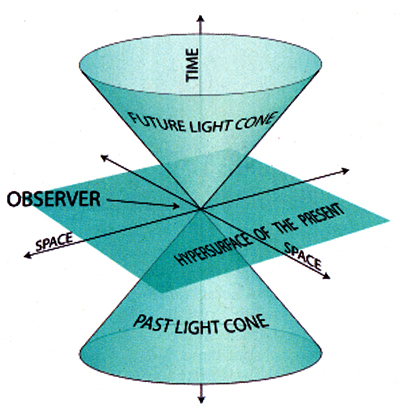
Subdivision of Minkowski spacetime with respect to an event in four disjoint sets.
Disproof of General Relativity
Although general relativity is the accepted description of gravitation in mainstream physics, this theory has a fatal flaw: 4D spacetime is a mathematical illusion. Logic tells us that geometrical spacetime is not real, does not exist, does not curve, and cannot impart gravitational energy.
Geometry is the mathematics which describes the properties and relations of points, lines, and surfaces – and the relative locations of objects. Mathematics is an abstract form of measurement and not a physical thing. As such, geometry cannot be the cause of anything. General relativity fails because it presumes that the physical force of gravity is caused by an abstraction (geometry) that has no physical existence – i.e., that no thing (nothing) is the cause of something (a physical force).
It gets worse: the mathematical construct of four-dimensional spacetime is fictitious, mythical. We use time as an abstract measurement of the duration and sequences of events and the changing positions of objects that occur within three-dimensional physical space. It is impossible (and nonsensical) to extract nonphysical time from physical space and project it onto a separate axis with its own independent set of reference points describing something that supposedly exists independently of the 3D.
General relativity depends entirely on the assumption that four-dimensional spacetime exists. But it does not. Spacetime is a mathematical fiction.
Spacetime theory imagines that three physical dimensions plus abstract time (i.e., not a physical thing) equals four physical dimensions. Algebraically we would represent this as 3•D + 0•D = 4•D – clearly an impossibility. Spacetime does not exist, does not curve, and thus cannot impart gravitational energy to things which do exist.
Einstein once said, "Whether you can observe a thing or not depends on the theory you use. It is the theory which decides what can be observed." It was from this perspective that Einstein and his advocates looked forward to the 1919 solar eclipse, in hopes that measured observations from it would provide the launching pad for his theory. And they did. Measurements taken from the 1919 solar eclipse made Einstein an overnight celebrity.
Solar Eclipse of 1919
Both Newton and Einstein predicted that beams of light passing close to the Sun would bend towards the Sun. Einstein's theory of general relativity, however, predicted a degree of deflection that was approximately twice as much as Newton's. The solar eclipse of 1919 provided evidence that appeared to confirm Einstein's prediction of how much gravity would bend light.
On November 9, 1919, page six of the New York Times carried this story: "Eclipse Showed Gravity Variation. Diversion of a light ray accepted as affecting Newton's principle. Hailed as epoch making. British scientist calls the discovery one of the greatest of human achievements." This vindication of Einstein's theory of general relativity was announced at a meeting of the Royal Astronomical Society.
Frank Watson Dyson, Astronomer Royal of Britain, conceived the perfect experiment to test Einstein's theory. A total solar eclipse on May 29, 1919 would occur just as the Sun was crossing the bright Hyades star cluster (about 151 light years away). Light from these stars would have to pass by the Sun's gravitational field on its way to Earth and would be visible during the darkness of the eclipse.
Arthur Eddington photographed reference positions of the Hyades stars during January and February of 1919 from Oxford, England (51.7520ºN, 1.2577ºW; temp 40ºF). Then in May, he went to the remote island of Principe (1.6139ºN, 7.4057ºE; temp 80ºF) to photograph the stars' positions during the eclipse.
Andrew Crommelin went to Sobral, Brazil (3.7015ºS, 40.3497ºW; temp 80ºF) in May to photograph the stars' positions during the eclipse, and stayed there to photograph reference positions two months after the eclipse. Both teams superimposed reference photos over the eclipse photos to see how much the Sun's gravity may have deflected light from the stars.

Solar Eclipse of 1919
No one seems to have taken parallax into consideration. Parallax is a difference or change in the apparent position of a celestial object as seen from different points on the Earth's surface. It is a natural phenomenon caused by viewing stars from different angles at various locations on the globe and can also be affected by atmospheric and seasonal conditions at those locations. Parallax alone could account for discrepancies in readings between Oxford and Principe, between Principe and Sobral, and between Sobral during the eclipse and Sobral two months afterward.
Deflection of light is measured in arcseconds. An arcsecond is 1/3,600 of a degree – or the angle made by the hypotenuse of a right-angled triangle one inch high and 1.9 miles long. This is an incredibly tiny deviation from which to estimate accurate deflections from the images of stars located 151 light years away.
Eddington's results from Principe showed an average deflection of 1.61 arcseconds. Crommelin's results from Sobral showed a deflection of 1.98 arcseconds. The average of these two readings, 1.795 arcseconds, was consistent with Einstein's prediction.
To put this deflection into perspective, consider that the diameter of the Sun has an angle of 1,800 arcseconds. A deviation of 1.79 arcseconds thus represents 1.79/1,800 = 0.01 per cent. A hundredth of one per cent apparent deflection from images 151 light years away could be due entirely to experimental error.
Only two photographic plates taken at Principe were usable, and each contained the same five stars. Five is too small a sample size from which to extrapolate statistically significant data.
Sobral had a problem in that their larger telescope had lost focus during the eclipse but regained that focus during the reference shots two months later. Dyson rejected these readings – which, if they had been used, would have yielded a deflection of 0.93 arcseconds (consistent with Newton's prediction). Thus, the two Sobral instruments were in significant disagreement with each other.
Results from the 1919 solar eclipse were used to decide whose predictions about deflection were more accurate, Einstein's or Newton’s. Einstein won by a small margin.
The Results from the 1919 solar eclipse are inconclusive. In his Brief History of Time, Stephen Hawking says of the 1919 deflection results: "Their measurement had been sheer luck, or a case of knowing the result they wanted to get." Hawking was reporting the widespread view that the errors in the data were as big as the effect they were trying to prove.
Newton predicted the bending of light as it grazed by the Sun's edge, but only by half as much as Einstein predicted would happen. The error factors from the 1919 eclipse measurements were so large as to make the results inconclusive. We have no way of knowing from these data who was right, Newton or Einstein.
Refraction
Einstein believed that it was the gravitational attraction of the mass of the Sun that would cause light to bend. Newton most probably held a different belief. In addition to his pioneering work in gravity, Newton also made pathbreaking contributions to optics, including the mechanics of refraction. Newton knew that light bends as it passes from air (low density) into water (high density) and described this phenomenon as light falling "much the way particles fall under gravity".
Gravity is a force of attraction between two mass-bearing objects. Light has zero mass and is therefore unaffected by gravity. Newton predicted that photons from distant stars grazing by the Sun's edge would ‘fall’ just a bit towards the Sun as they passed by, resulting in a slightly curved trajectory. This is because the photosphere (luminous envelope) immediately surrounding the Sun is denser than the space through which distant light beams travel.
Our Sun is a super massive ball of gas that is believed to have an average density of about 1.4 times that of water. The photosphere, the outer region of the Sun that is transparent to photons, may have a density less than that of water but still enough to refract light that passes through this dense gaseous medium.
Refraction of light passing close by stars is commonly observed but misnamed as gravitational lensing. A gravitational lens is believed to be a distribution of matter between a distant light source and an observer that bends the light as it travels toward the observer. Gravity cannot bend light, but refraction can.
Gravity does not bend light. Spacetime does not impart gravity.
The Gravity of the Situation
With his curvature of spacetime theory, Einstein was essentially saying that gravity is the result of
the mass of an object bending space – that objects fall because the space in which they are is bent. This is convoluted logic. It is a statement that the mass of a very large object (a) does not exert any direct gravitational pull on anything around it, but (b) directly influences the shape of (fictional) spacetime, and (c) spacetime in turn exerts the gravitational pull on nearby objects.
In 1917, the interpretation of general relativity theory was that the curvature of space is variable in time and space according to the distribution of matter, and spacetime can roughly be interpreted to be spherical in shape, and the curvature of hypothetical four-dimensional spacetime continuum is defined at every point by the matter at that point and the state of that matter.
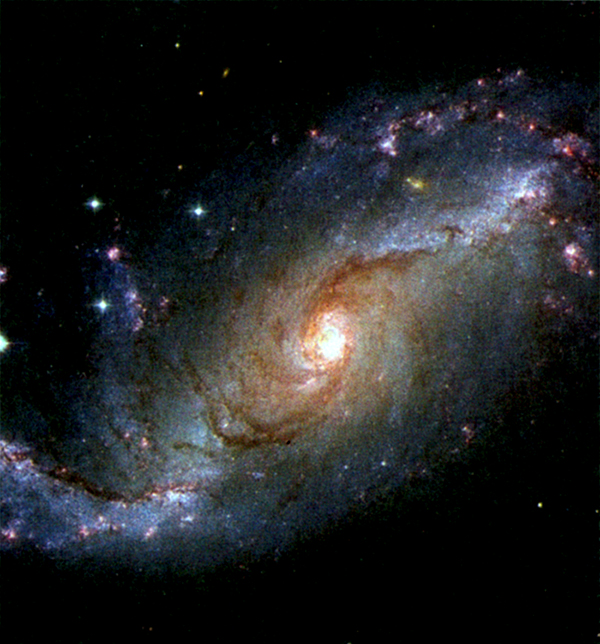
What the above unsupportable conclusions suggest is that the Universe is spherical in shape and what gives it this overall spherical shape is a kind of collective gravity. Fictional spacetime has thus given rise to the untenable general relativity theory, which is used as support for the mythical "big bang" theory which falsely presumes that a super colossal explosion created a spherical Universe that is continually expanding (see NEXUS 25/06).
Gravity is a localised phenomenon. Two objects attract each other in proportion to the product of their masses and in inverse proportion to the square of the distance between them. This means that any given star, depending on its mass, can attract nearby planets, rocks, debris, etc. from only so far away. At a certain distance, its gravitational pull on anything else in space becomes negligible.
In any given galaxy, stars are separated from each other by huge distances that preclude any force of gravity acting between them. If this were not so, then through time all stars and planets in any cluster would eventually clump together to form one unfathomably humungous star, and the concept of galaxy would have no meaning.
Since stars within a galaxy are too far apart to be able to exert any gravitational pull on each other, there is no way that the entire galaxy (as a unit) could have a collective gravitational pull on anything outside of itself. To estimate the total mass of any galaxy would be a pointless pursuit, because whatever that number turns out to be exerts zero gravitational pull on anything else.
Similarly, no collective grouping of galaxies exerts any gravitational pull on anything. No matter how many galaxies with zero external gravitational pull you add together, the total gravity pulling on any other part of the Universe is still zero.
It is not possible for the gravity of any star, galaxy, or collection of galaxies to have any influence on the shape of spacetime, for two reasons: (1) that is not how gravity works, and (2) spacetime is a mathematical fiction; it does not exist, has no shape, and does not curve.
It is not possible for the Universe to have any specific shape. If we define "Universe" to mean "all existing things", then we must conclude that the Universe has no shape, no boundaries, and no edges – because to have a boundary implies that something else exists on the other side of that supposed dividing line. If something were to exist on the other side of the Universe's (imagined) edge, then, by definition, that something is also part of the Universe. Thus, to conclude that the Universe has a shape is to commit the fallacy of self-exclusion – i.e., the Universe (everything that exists) can have a shape only if something other than the Universe also exists.
If the Universe has no shape, then that non-shape cannot be increasing in size. The Universe is not expanding. Individual galaxies may be getting larger, but collectively they are not expanding outwards.
David Rowland © 2019
Reproduced from NEXUS, Vol 27, No.1.
About the Author
David Rowland is an independent researcher, member of the Royal Astronomical Society of Canada and author of the books What We Know About the Universe That Isn't So: Science at a Crossroads and The Origin of Everything: Uniting Science and Philosophy. Rowland's article "A Big Bang Never Happened" appeared in NEXUS Vol 25, No.6 (October-November 2018).

This article is licensed under
a Creative Commons License

AULIS Online – Different Thinking