Two Surprises for Stonehenge Watchers
Spring/Summer 2024
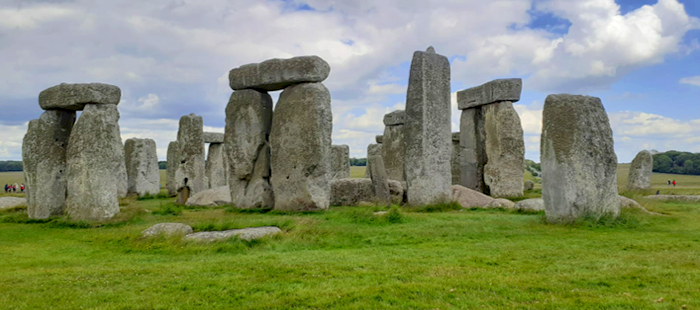
Fig 1. View of the trilithons, June 2024. Standing at over 21ft with its visible tenon and polished exterior surface is elegant Trilithon 56. We see complete views of trilithons 53 & 54 to its right; trilithons 57 and 58 in the foreground to its left. Both sets are capped with their lintels. Photo: K Bennett-Villeroy
Spring: At 9pm in the UK on 31 March 2024, Channel 5 TV aired a new documentary titled Stonehenge: The Discovery with Dan Snow. This was first screened on Easter Sunday, and for many in the UK, the Easter weekend constitutes a holiday, so the audience for this program might have been less than for a normal Sunday night’s viewing. The ‘discovery’ element was to be the revelation of the location now considered to be the source of the sarsens comprising the inner horseshoe trilithons and the surrounding stone circle.
Long rumoured to have come from the Avebury area, we were informed that it had not been possible to analyse the sarsens until now. Visiting the actual source of these huge sarsens was specifically dealt with in the very last segment of the documentary, and while bearing in mind this was made for TV, and not an academic study, it was nonetheless wildly inaccurate. The rest of the program was not without its moments.
The production starts off with a preliminary segment on how these sarsen might have been moved across land. The once fashionable hypothesis that our ancestors dragged the sarsen stones across wooden tree trunks acting as rollers has apparently been replaced. It is now suggested that they more than likely strapped the stone to a wooden sledge, and with some form of greasing to facilitate their effort, they simply pulled it across the surface.
To convince the viewer as to the validity of this method, 50 people undertake to heave a small sledge carrying a 1.5-ton sarsen over flat ground in marginally wet weather. Of the two attempts that made it into the documentary, the first produces no movement, the second filmed the sledge being pulled along a very flat surface for a distance of several yards! As per the former roller experiments of yesteryear, this endeavour is then considered to be the preferential method of our ancestors for heaving sarsen and it was opined that our ancestors would choose rainy weather during which to achieve successful sledging.
The viewer is asked to imagine how much more amazing it would be when considering stones of some 20 tons in weight. Yes indeed! But no mention is made of the fact that the maximum weight for the Stonehenge sarsens is estimated at 30 tons.1 Admittedly that is 20 times the weight of this experimental sarsen, and the scriptwriter might have got in a muddle between the ’20 tons’ and ’20 times’, but on the evidence of this particular sledge experiment, if our ancestors had the same pulling power as today’s human beings, it would have taken 1000 people to even trigger the movement of a 30-ton sarsen.
It is more than likely that our ancestors had literally, far more pulling power than modern mostly sedentary human beings, but even so, this demonstration over specially prepared flat ground does not take into account any sort of hilly or difficult terrain that might be encountered on the journey. How far would the stone have to be pulled by this sledge method? Where was the source of the sarsen? And how to determine the authenticity of that source?
Identity Parade: ‘Come In, Number 58’
For the ‘how’ we are informed that in 20172 a sarsen core sample taken from trilithon No.58 had fortuitously been returned to English Heritage from the USA and from this it has been possible to extract a small amount for chemical analysis.3 With such an opportunity, it was decided once and for all, to try to isolate the point of origin of the huge sarsens that make up the circle and the horseshoe elements of this monument. We are spared over much technical details of this work,4 but we did learn that to start with, a limit of a 10-mile radius around Stonehenge was established and all sources of sarsen within that perimeter were examined for trace elements that were not silica, using No.58’s core sample as the benchmark. No joy. Then samples from multiple sites right across southern England were also considered. Still no joy. None came close to matching No.58.
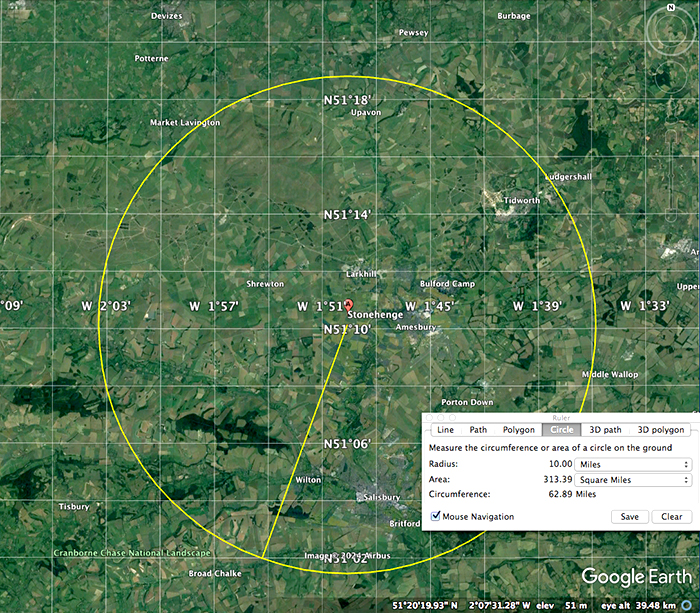
Fig 2. The radius of 10 miles initially chosen for the sarsen research. Google Earth Pro, additional annotation M Bennett.
Having eliminated the very close and the very distant, the radius around Stonehenge was only then increased to include the historically-favoured source for these of gigantic sarsens: Avebury and the surrounding area.4
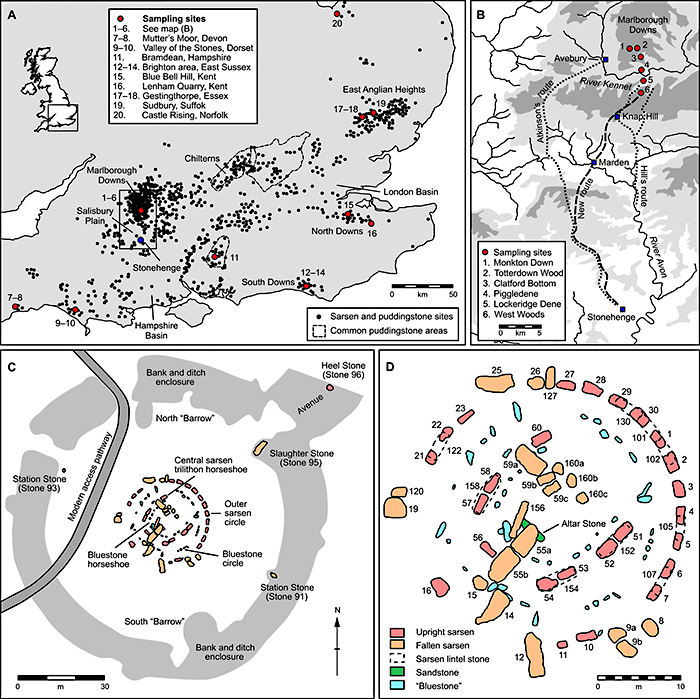
Fig 3. The sarsen sites selected for analysis a) the south of England b) the Avebury area c) the position of the sarsen within Stonehenge d) designation of their condition. Source: Science Advances, CC BY-NC 4.0.
Having dealt with the background, the last part of the TV program cuts to the chase and we see the presenter accompanied by a scientist, driving into the pretty village of Lockeridge Dene and parking. Located in a valley to the south east of Avebury, we see charming thatched cottages built of the local sarsen, and we see that the verdant foreground beside their car is strewn with many medium-sized sarsens. The technical term for such a sarsen-strewn valley, is a sarsen train and having dismissed these as being useful for Stonehenge,5 the presenter is instructed to drive on ‑ they are headed for West Woods, less than a mile away. Once part of the Savernake forest, this predominately beech woodland is still home to many substantial sarsens.
The Science Bit
Without any further preamble the scientist gives a demonstration as to how the analysis of a stone was undertaken and it is now revealed that it is this particular location that produced the closest match with No.58’s core sample. Although it should be noted that in this documentary the scientist on site does not use the word ‘exact’. Nor does she comment (on screen at any rate) on the presenter’s next statement. As is normal in these types of documentaries, the presenter repeats a statement just given by the science person, in order to help viewers allergic to sciencespeak understand what has just been said.
So the presenter, looking hopefully at the scientist while summing up the previous science demonstration, now asserts that, given this analysis, all the scientists are happy that this is the source of the Stonehenge sarsen. Before we get any affirmation from the scientist on this point there is a cut. As the scientist had not actually said that, I felt that the agreement of science on that point was not conclusive.
After watching the program I consulted the documentation concerning this chemical analysis of the sarsen No.58, within which the words, ‘closest’ and ‘similar’ are used. Given the number of tests undertaken for this whole experiment, that meant: ‘the closest out of all the samples tested’ and ‘similar in composition to the tested West Wood sarsen’. I also consulted How to Build Stonehenge by archaeologist Mike Pitts. In discussing this experiment he observes that a sample from one trilithon is not perhaps sufficient to confirm that all the sarsens at Stonehenge derive from the West Woods location.6 Appreciating better the reasoning behind that abrupt cut, here’s what happened next.
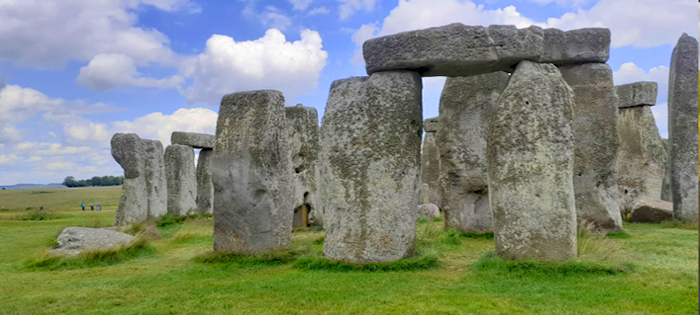
Fig 4. Stonehenge, June 2024. The outer sarsen circle seen from the northwest. In the foreground stones nos.21 and 22 capped by their lintel. Just visible behind the single no.23 is the trilithon no.60, with its tenon. The back of this trilithon formed a large, natural hollow into which visitors used to squeeze. Photo: K Bennett-Villeroy
All Deliveries Undertaken – Distance No Object
There was no such difficulty for the presenter. Having resolved to his satisfaction the point of origin, immediately following that cut it was time to deal with the distance these stones must travel to arrive at Stonehenge. And again accuracy is not to the forefront when the presenter emphatically informs us that the distance from West Woods to Stonehenge is 8 miles. Eight miles! Even if his script was in error, and this was supposed to mean another 8 miles further out from the primary ten mile radius limit, this was still inaccurate. From the location of the test site in West Woods [51°23’ 52.62”N; 001° 47’ 31.80”W] to the centre of Stonehenge 'As the Crow Flies' (that sarsen ‘radius’) it is some 15.22 miles.
However, when using the ancient footpath routes across this landscape this distance is over 23 miles. Here’s the thing: Dan Snow is not only a historian, he is also an old hand at presenting Stonehenge documentaries. In an earlier documentary he had stated that the sarsens found in West Woods are sited 25km (15.52miles) from Stonehenge. So he knows the distance very well in both kilometres and in statute miles. Yet in this production the erudite historian allows this distance of 8 miles to stand. And just in case we have not grasped the import of this fact, the second time around while he states those 8 miles, we see a map on screen showing us the route, leaving this viewer totally astonished, to say the least.
Nor was this ridiculous distance corrected by his equally experienced director, Nick Gillam-Smith. I thought it impossible that the production company had not spotted this monumental error before it was broadcast, so I sent an email to Gillam-Smith asking why this distance of 8 miles was allowed to stand? No answer came, so a week later I sent a follow-up email and this time I did get a reply, from the program’s producer, Bill Locke. Nitpicking my way through his answer was educational, he wrote:
…Thank you very much for pointing out the error we made on the distance between West Woods and Stonehenge. You are quite right that it is further than the 8 miles we stated.
We hold great store on being factually accurate, but on this occasion made a mistake. I have checked through with the director, Nick Gillam Smith, about how this came about. We believe it was the result of a simple misunderstanding during our research, thinking the actual distance in miles stated by the experts, was referring to kilometres. We then erroneously recalculated it in miles.
This mathematical contortion is not credible, as any small exercise with a calculator will demonstrate. However, the use of ‘we believe’ rather than ‘we know’ together was his final paragraph gave me an indication of where they were coming from:
Being reminded by you of the greater distance involved makes the achievement of the Neolithic people who moved the giant sarsens to Stonehenge even more remarkable.
While hoping that I was not the only person to point out the discrepancy, given the expertise present on set both in front and behind the camera, and the fact that this discovery of the actual location relative to the monument’s site was the whole point of the program, I wondered how it was possible for this set of professionals to truly forget the actual distances involved. In replying to Bill Locke I pointed out that the maths answer he had provided was invalid, but I agreed with him that the actual distance between the two sites did indeed emphasise: “the extraordinary undertaking of moving Sarsens weighing up to 30 tons over difficult terrain,” and I added, “…from that point of view, any shortening of the distance between these two sites must be considered something of a relief for all those concerned.”
I also trusted that they would find a way to correct this mistake for future showings. I received no further comment from the filmmakers. So with regard to this particular production, that sought-after factual accuracy remains an aspiration. The program has already been repeated with no adjustments or added subtitles to correct their ‘mistake’.
Let me not to the marriage of true minds – admit impediments
Thinking about this program and its ramifications I thought that those 8 miles might represent a possibly unwitting attempt at avoiding the real problem that skewering the source of these huge sarsen stones has placed on the high table of academe. Could it be that the sledge experiment shown in the first part of this documentary actually revealed that the transportation of huge sarsen across 15.73 miles of rough terrain was not simply a matter of relying on frictionless surfaces? How much more difficult heaving huge sarsens up hill and down dale?
It has until now been considered acceptable by archaeologists to conclude that the source of the sarsens was ‘probably the Marlborough Downs area’. Without specific and acceptable proof, it was legitimate for archaeologists to dismiss any enquiry about the ‘how’, especially from the general public, as mere speculation. But now, faced with a definitive chemical analysis that places – at the very least one huge stone in West Woods – the decades of avoidance of the obvious is over. And thereby lies the crux of the matter: How did our ancestors actually manage to haul these huge sarsen across exceedingly undulating and challenging terrain? in this instance. It has been asserted that the available river system from north Wiltshire down to Stonehenge, at the estimated time of building, would not support the transport of these sarsens.7
In 2012, another Discovery Channel TV program featured a successful attempt to replicate the moving of a stone of equivalent bluestone dimensions by boat – up a river.8 The means by which these Welsh bluestones were moved is still an ongoing debate. As it is for the sarsen.
Love is not love, which alters when it alteration finds…
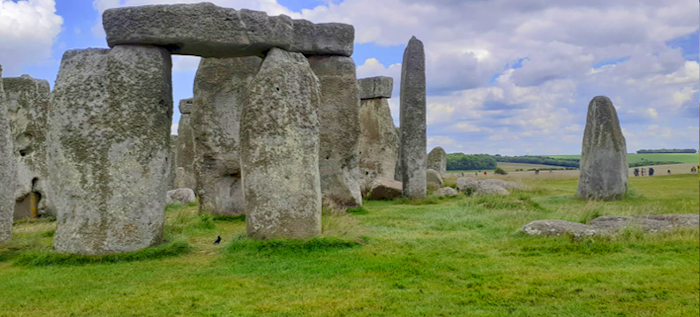
Fig 5. A view directly onto trilithon 56 and the location of the Altar Stone near its base, June 2024. To the left, the smooth tan-coloured block seen within the rough outline of trilithon no.60's 'hollow' is a concrete infill that restricts access. It was installed by the Ministry of Works in 1959. Photo: K. Bennett-Villeroy
Summer: If fudging the distance between heavy sarsen and Stonehenge enabled this issue of moving mass over distance to be skirted around for most of the people who would ever see this documentary, it would be a short lived victory. Five months later, in August 2024 it was revealed to the general public that the darker stone lying at the centre of Stonehenge, known as the Altar Stone, came from an even greater distance.
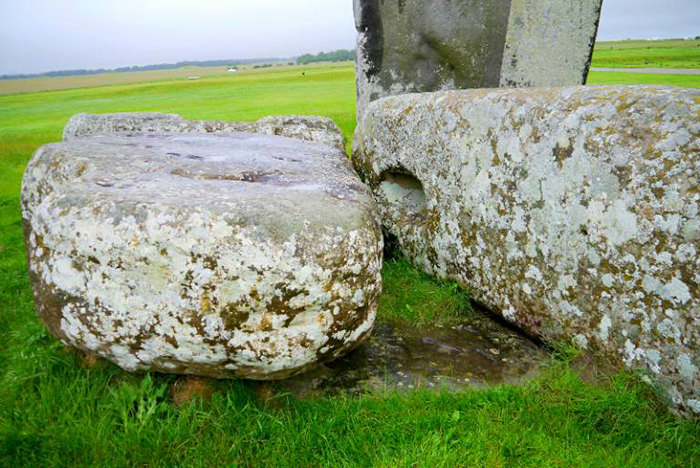
Fig 6. The dark coloration of the altar stone is in stark contrast to the paler sarsen that have apparently felled it during their own collapse. To the left of image is trilithon 55, which has broken into two pieces. To the right is the fallen lintel 156 that capped trilithons 55 and 56. The altar stone is considered to have been standing in the gap between these the tallest of the trilithons, of which 56 is still standing. Incidentally, that lonely sarsen survivor is polished on its exterior surface, the other pairs of trilithons are polished on their interior surfaces.9 Image: ucl.ac.uk.
Lying on the ground masked by fallen sarsen from the tallest trilithon pair, the Altar stone is just over 16ft/5m in length and has been evaluated as weighing some 6 tons, and was until now, also considered to have originated from somewhere in Wales. Studies of the chemical fingerprint of this stone has now established that this stone is of the type classified as Old Red Sandstone, found only in the northeast of these British Isles – in Scotland to be precise, in an area known to geologists as the Orcadian Basin.
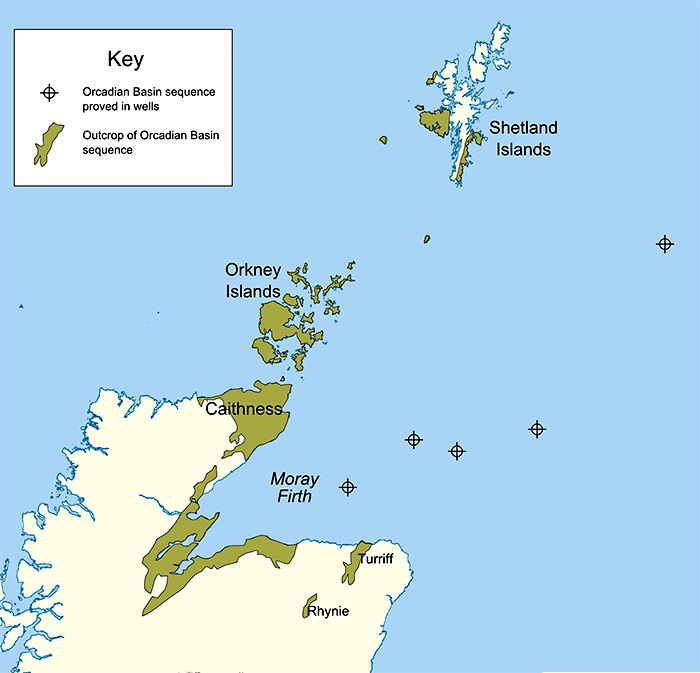
Fig 7. The Old Red Sandstone areas of north east Scotland showing the extent of the Orcadian Basin in terms of outcrop and occurrence in offshore hydrocarbon exploration wells. Map modified after Norton et al., 1987 and Duncan & Buxton 1995. Image Mikenorton, CC BY-SA 3.0.
Academic opinion thus far considers it most unlikely to have originated any further than the north east coast of the mainland, a distance of some 434 miles/700km from Stonehenge. But until these same individuals can establish exactly how this was moved down south, all bets are off. It may be nearest to Stonehenge on the mainland, but that particular rock runs north eastwards for another 262miles/ 422km taking in all of the nearer Orkney islands as well as parts of the Shetland Isles.
So until we know any better, there is a range of some 696miles/ 1122kms to consider when thinking about the transportation of the Altar Stone from its point of origin down to the British monument. Current thinking suggests the land route and suggests, sensibly, that this might have taken years to achieve. Others think that the sea route around Scotland down through the Irish sea to be a better option. Pictures of appropriate craft emerge, while earlier experiments in sea transportation of a small Preseli stone are by and large not mentioned. These smaller stones weigh in at some 2-4 tons, yet in the Welsh experiment, at the very start of its voyage, the stone sank to the bottom of the sea just off the coast of Wales.
...Or bends with the remover to remove
There is not only the ‘how’, which is currently unresolvable, there is also the ‘why’ it was considered necessary to incorporate this stone into the very heart of Stonehenge. And for modern archaeologists, that seems to be somewhat of a difficulty. The current response to this new discovery is to consider that the organisation and transport of such a stone would likely be a group effort in order to retain control of disparate tribes, cultures, and a means of coping with incoming refugee populations from the continent. it looks as if in seeking to continue a narrative for Stonehenge, present day cultural events on these islands are clouding the ability to truly consider this discovery.
But then as Jaquetta Hawkes observed, "Every age gets the Stonehenge it deserves." No doubt large building projects such as Mexico’s Teotihuacan and Egypt’s Giza Plateau have also influenced this type of response – yet archaeologists surely remember that from these two pyramid sites alone, there is evidence of distant and cross-cultural travel. The mica imported into Teotihuacan’s Sun pyramid and its avenue, the red granite installed in the King’s chamber in Giza’s Great Pyramid are reminders that across the world, our ancestors were very much accustomed to importing geological materials from a considerable distance. The Old Red Sandstone of the Altar Stone contains glittering Mica minerals.
Despite such precedents, this connection of Scotland to Stonehenge has set the archaeologists all of a flutter, that this Altar Stone was transported such a long way from its source is considered by the profession to be jaw-dropping news’.10 For others, perhaps less so. Julian Cope, the musician and author, writing in his Gazeteer of Megalithic Britain, The Modern Antiquarian, notes how the Maes Howe tumulus and the remarkable stone circle of Brogar at Stenness in the Orkney Isles have been associated with Avebury and Stonehenge, and those visiting these Scottish sites have wondered if their builders were inspired by those southern builds.11
I ask, as do others, why not the inverse? In much the same way that many archaeologists now consider the possibility that Stonehenge was intended to prime the Winter Solstice sunset, rather than the Summer Solstice sunrise, thinking backwards might be helpful here.
So Near and Yet so Far
If we truly want to know how these huge stones were moved around these islands, if we wish to understand why the relationship between materials used, and the distance from point of origin to site was important to the builders of this unique monument, then that might require a different approach. Opening up new ways of thinking might require the exploration of technologies that are unfamiliar to many and even provide answers that will uncomfortable for some. One thing is certain: adjusting or ignoring the reality to suit our various prejudices is not going to be way forward when confronting the conundrums this Old Red Sandstone Altar Stone presents to us. With this latest discovery, the cat is out of the bag.
Mary Bennett
Aulis Online, August 2024
Footnotes
1. For a 1997 appreciation of experimental engineering concerning Stonehenge see The Engineering of Stonehenge by Julian Richards & Mark Whitby, Proceedings of the British Academy, No.92.
2. More accurately the core actually arrived in the UK 2018 according to archaeologist Mike Pitts’ account of this event. See Ch.3 pp 64-65 of How to Build Stonehenge published by Thames & Hudson, London, 2022, ISBN 978-0-500-02419-5.
3. Sir William Flinders Petrie instigated the numbering system for the stones when surveying Stonehenge between 1874-1877. Looking out from the centre of the monument, the trilithons are numbered from the right of the central axis. So we have five pairs: 51-52, 53-54, to the right of the axis; 55-56 on the central axis; 57-58, 59-60 to the left of this axis. Coincidentally, sarsen No.58 was under repair in 1958 when the core under discussion was removed, along with two others. See Pitts pp 56-65 (q.v) for a full account of the earlier work on stone 58 and these three cores.
4. Not mentioned in the program but available within the technical documentation, we learn that 12 samples were taken from six sites in the Avebury area.
5. Although Dan Snow is a historian it was not deemed necessary to tell the viewer that this sarsen train in Lockeridge is nothing like what was present centuries ago. Before the National Trust bought this land to protect this particular train, the sarsen in this area had been much used for house building and then road building. In Wiltshire sarsen are also known as Grey Wethers, (male sheep reserved for the wool trade) because when seen from a distance they look like grazing sheep.
6. Mike Pitts view of this matter q.v. How to Build Stonehenge, Ch3 pp72-76 (q.v.)
7. Tim Daw, The Source of the Altar Stone Fragment, Sarsen.org
Also: The Stonehenge Sarsens didn't float down the Avon.
8. But that was then, in 2015 it was pronounced that the Preseli bluestones (located to the north east of St. Davids) did not come from the south face of the eponymous outcropping of volcanic and igneous material that make up these bluestones, but from the north face. As such from henceforth the considered way to move them was going to be overland.
9. The Stonehenge Altar Stone came from Scotland, not Wales.
10. Stonehenge megalith came from Scotland, not Wales, ‘jaw-dropping’ study finds, The Guardian.
and Stonehenge’s altar stone was carried all the way from north-east Scotland. But how? The Guardian.
and Does Stonehenge stone’s Scottish source reveal a project uniting ancient Britain? The Guardian.
10. Map of Orcadian Basin: Mikenorton, CC BY-SA 3.0
11. A Modern Antiquarian, Julian Cope, Thorsons, an imprint of Harper Collins, London 1998, pp414-417.
Also: Moray and Caithness: A Landscape Fashioned by Geology, Clive Auton, Jon Merritt and Kathryn Goodenough, Scottish Geology Trust.
and here: Orkney and Shetland: A Landscape Fashioned by Geology, Alan McKirdy, Scottish Geology Trust.

